

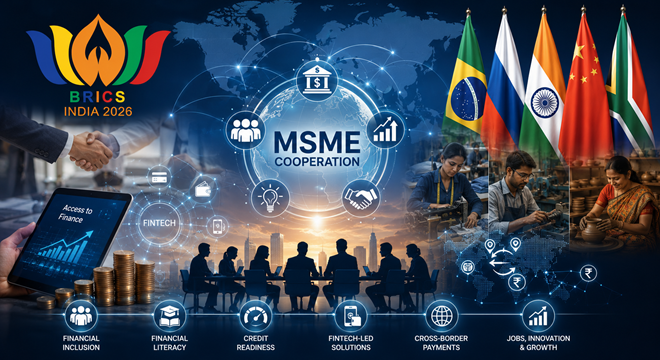
India’s MSME sector is increasingly looking beyond domestic markets as BRICS partnerships create new opportunities in trade, technology, investment, and market access. Enhanced cooperation among emerging economies could help Indian small businesses expand globally while strengthening their competitiveness.
BRICS Partnerships Open New Doors for Indian MSMEs
India’s MSME sector is exploring new growth opportunities through BRICS partnerships as the country seeks to strengthen economic cooperation with fellow emerging economies. The development has gained attention following recent discussions among BRICS member nations focused on trade, innovation, entrepreneurship, and business collaboration.
Micro, Small and Medium Enterprises (MSMEs) contribute significantly to India’s economy through employment generation, manufacturing output, exports, and regional development. However, many small businesses continue to depend heavily on domestic demand for growth.
As global trade patterns evolve, Indian MSMEs are increasingly looking at international markets to diversify revenue streams and reduce dependence on a single market. BRICS cooperation provides a platform where businesses can connect with potential buyers, suppliers, investors, and technology partners from some of the world’s fastest-growing economies.
For many enterprises, especially those located outside major metropolitan regions, these partnerships could create opportunities that were previously difficult to access.
Why Global Market Access Matters for Small Businesses
One of the biggest challenges faced by Indian MSMEs is scaling beyond local and national markets. While India remains one of the world’s largest consumer markets, international expansion offers businesses the chance to reach larger customer bases and increase profitability.
Export-oriented growth can help small manufacturers, technology firms, food processing units, textile producers, and service providers gain access to new demand centers. Countries within the BRICS grouping represent billions of consumers and significant industrial demand.
Indian businesses that successfully enter these markets can benefit from higher sales volumes, diversified customer portfolios, and stronger resilience against domestic economic fluctuations.
In addition, global exposure often encourages companies to improve product quality, adopt international standards, and invest in innovation. These improvements can strengthen competitiveness both at home and abroad.
As a result, international partnerships are becoming an important component of long-term business growth strategies for MSMEs across India.
Trade and Technology Collaboration Under BRICS Cooperation
Beyond exports, BRICS partnerships offer opportunities for technology collaboration and knowledge sharing. Many MSMEs face operational challenges related to productivity, digital adoption, manufacturing efficiency, and supply chain management.
Through business forums, trade missions, and industry interactions, Indian entrepreneurs can learn from successful practices adopted by businesses in other BRICS countries.
Technology transfer can play a particularly important role in sectors such as manufacturing, agriculture, renewable energy, logistics, and digital services. Small enterprises that gain access to advanced tools and processes can improve efficiency and reduce operating costs.
Collaboration may also create opportunities for joint ventures, research partnerships, and innovation-driven projects. Such initiatives can help MSMEs develop new products and enter emerging sectors that require specialized expertise.
As digital transformation accelerates globally, technology partnerships are becoming as valuable as traditional trade agreements.
Opportunities for Tier-2 and Tier-3 Entrepreneurs
The growing focus on BRICS cooperation could have a meaningful impact on entrepreneurs operating in Tier-2 and Tier-3 cities. Business hubs such as Nagpur, Indore, Surat, Coimbatore, Jaipur, Lucknow, and Bhubaneswar are witnessing increasing entrepreneurial activity across manufacturing, services, agribusiness, and technology sectors.
Many of these businesses produce high-quality products but lack international visibility and market connections. Participation in global business networks can help bridge this gap.
Government initiatives such as Digital India, Startup India, Make in India, and various MSME support schemes have already improved the business environment for smaller enterprises. International cooperation through BRICS can further enhance these efforts by connecting local businesses with global opportunities.
For entrepreneurs in emerging cities, access to export markets and international partnerships could become a major growth catalyst over the next decade.
Challenges That MSMEs Must Overcome
While the opportunities are substantial, Indian MSMEs must also address several challenges before they can fully benefit from global expansion.
Export compliance, quality certifications, logistics costs, financing constraints, and regulatory requirements remain significant barriers for many small businesses. International competition can also be intense, requiring companies to continuously improve their products and services.
Building export readiness requires investment in technology, workforce training, product development, and market research. Businesses must also understand consumer preferences and regulatory standards in target markets.
Industry experts believe that government support, business associations, and international cooperation platforms will be crucial in helping smaller enterprises navigate these challenges.
The success of BRICS partnerships will ultimately depend on how effectively businesses convert networking opportunities into long-term commercial relationships.
What the Future Holds for India’s MSME Sector
India’s growing engagement with BRICS economies reflects a broader strategy of strengthening economic ties with emerging markets. As global supply chains continue to diversify, Indian MSMEs are well-positioned to play a larger role in international trade.
The combination of manufacturing capabilities, digital infrastructure, entrepreneurial talent, and government support provides a strong foundation for future growth.
If trade facilitation measures, technology partnerships, and business collaborations continue to expand, Indian MSMEs could significantly increase their global presence in the coming years.
For small businesses seeking sustainable growth, BRICS partnerships represent more than a diplomatic initiative. They offer a practical pathway toward international expansion, innovation, and long-term competitiveness.
Key Takeaways
- BRICS partnerships are creating new export and business opportunities for Indian MSMEs.
- Global market access can help small businesses diversify revenue and improve competitiveness.
- Technology collaboration and innovation sharing are key benefits of BRICS cooperation.
- Entrepreneurs from Tier-2 and Tier-3 cities may gain greater international exposure and market access.
FAQs
What are BRICS partnerships?
BRICS partnerships refer to economic, trade, and business cooperation among BRICS member countries aimed at strengthening collaboration and development.
How can Indian MSMEs benefit from BRICS cooperation?
MSMEs can benefit through export opportunities, technology exchange, business networking, investment prospects, and access to new markets.
Why are Tier-2 and Tier-3 businesses important in this context?
Many regional businesses have strong growth potential and can use international partnerships to expand beyond local and domestic markets.
What challenges do MSMEs face when entering global markets?
Common challenges include export compliance, financing, logistics, quality standards, regulatory requirements, and international competition.
(Keywords: India MSME Sector, BRICS Partnerships, MSME Export Growth, Small Business India, BRICS Trade Opportunities, MSME Global Expansion, Tier 2 Entrepreneurs, MSME Market Access, Indian Exporters, BRICS Business Cooperation)









Leave a comment