

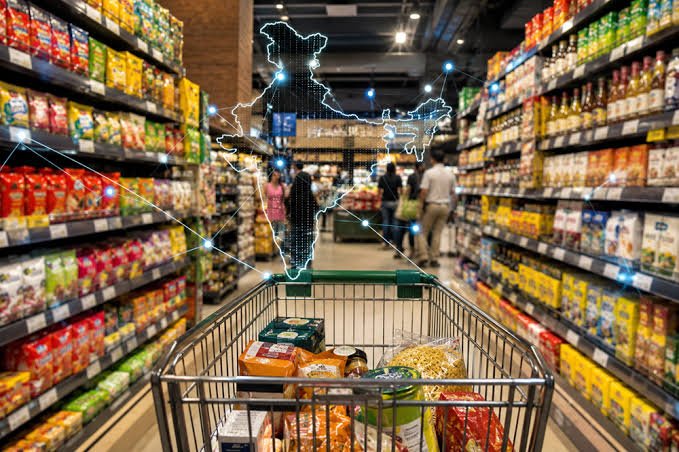
India’s FMCG sector is increasingly looking beyond major metros as smaller cities, rural markets and semi-urban consumers become important sources of incremental demand. Rising incomes, wider distribution, digital access and changing consumption patterns are reshaping how consumer companies plan their next phase of growth.
FMCG Growth Is Moving Beyond India’s Metros
FMCG companies are increasingly focusing on smaller cities and rural markets as India’s consumption story becomes more geographically diverse. Recent industry data shows that growth patterns are no longer uniform across urban and rural India, forcing companies to rethink where and how they invest.
NIQ’s Q2 2026 FMCG snapshot says India’s FMCG market continues to experience changing channel dynamics and diverging growth patterns between rural and urban markets. The report also found that e-commerce accounted for 7% of FMCG sales nationally, highlighting the expanding role of digital channels alongside traditional retail.
The shift is important because India’s largest cities already have relatively mature distribution networks and high brand penetration. For consumer companies looking for additional volumes, smaller markets can provide room for wider distribution, new consumers and category expansion.
This does not mean metros are losing their importance. Instead, FMCG companies are increasingly building a broader growth strategy that combines metro demand with opportunities in Tier-2, Tier-3, Tier-4 and rural markets.
Tier-2 and Tier-3 Cities Become Consumer Growth Centres
The expansion of smaller-city consumption is being supported by changes in income, infrastructure, digital adoption and consumer aspirations.
A July 2026 report by India Today, citing the Dainik Bhaskar Group and Kantar’s Urban Bharat consumption study, identified cities such as Lucknow, Jaipur, Indore, Surat, Patna and Bhopal as increasingly important consumption centres. The report highlighted rising incomes, digital adoption and changing lifestyles as factors supporting consumption beyond the largest metros.
This creates opportunities across multiple FMCG categories, including packaged foods, beverages, personal care, home care and health-oriented products.
Consumers in smaller cities are also increasingly exposed to national and international brands through social media, e-commerce platforms and digital advertising. As a result, product discovery is no longer restricted to what is available at the nearest neighbourhood store.
For FMCG companies, the challenge is converting this awareness into regular purchases through the right combination of pricing, pack sizes, availability and distribution.
Rural Demand Remains Important for FMCG Companies
Rural India continues to play an important role in the FMCG growth equation. NIQ’s earlier 2026 data showed that rural markets had outpaced urban consumption growth for eight consecutive quarters, although the gap narrowed in the October to December 2025 period.
In that quarter, rural FMCG volume growth was 2.9%, compared with 2.3% in urban markets. NIQ also noted that urban consumption was supported by a recovery in metro markets and changing e-commerce demand.
The latest environment is more mixed. A weak monsoon and inflationary pressures were identified as risks to rural consumer demand during the July to September 2026 period. The Economic Times reported that FMCG companies remained cautious about the impact of these factors even as rural expansion had accelerated in the preceding period.
This explains why companies cannot treat rural India as a single market. Consumption can vary significantly between states, districts, income groups and product categories.
Tata Consumer Shows the Scale of Smaller Markets
The growing importance of non-metro consumption can also be seen in the distribution strategies of large consumer companies.
Tata Consumer Products reported that more than 65% of its FY26 India revenue came from Tier-2 to Tier-4 markets. The company also reported that these markets were growing 1.5 times faster than metros, while its distribution network reached about 20 lakh retail outlets and more than 16,000 villages with populations below 50,000.
The numbers illustrate why distribution remains central to FMCG expansion. A consumer may be aware of a brand through a mobile phone, but the sale still depends on whether the product is available at the right price and in a convenient location.
For smaller markets, this can mean strengthening wholesale networks, rural distributors, direct retail coverage and regional warehousing.
Companies may also need different strategies for cities such as Nagpur, Indore or Jaipur compared with smaller towns and villages surrounding them.
Smaller Packs Still Matter in Price-Sensitive Markets
Affordability remains an important consideration as FMCG companies expand outside major urban centres.
NIQ’s 2026 research has highlighted pricing pressure and the importance of pack architecture, including smaller price-point packs such as ₹5 and ₹10 products. The agency’s Q1 2026 report described India’s FMCG market as moving toward more selective, channel-led growth while affordability dynamics continued to influence purchasing decisions.
Smaller packs allow consumers to try products without committing to a larger purchase. They can also help companies reach households where spending is more sensitive to income fluctuations.
At the same time, companies are also exploring premium products in smaller cities. This creates a two-sided market in which affordability remains important, but consumers with rising disposable incomes may also spend more on categories such as beauty, nutrition, personal care and packaged foods.
The result is a more fragmented consumer landscape rather than a simple rural-versus-urban divide.
E-Commerce and Quick Commerce Change Distribution
Digital commerce is another reason FMCG companies can no longer define growth purely through physical retail expansion.
NIQ reported that e-commerce accounted for 7% of FMCG sales nationally in Q2 2026. Modern trade and e-commerce were identified as important drivers of incremental growth, while traditional retail continued to play a major role across the country.
Quick commerce has been particularly influential in urban markets, where consumers increasingly use digital platforms for everyday products. Its expansion also gives brands another route to reach consumers without building the same physical retail footprint in every location.
However, digital channels are not a replacement for India’s neighbourhood stores. The scale and reach of traditional retail remain critical, particularly in smaller cities and rural areas.
FMCG companies therefore need a combination of physical distribution and digital availability. The balance can differ substantially from one market to another.
Why Micro-Markets Are Becoming More Important
Consumer companies are increasingly looking at individual micro-markets rather than treating an entire state or city as one consumer group.
Recent reporting by The Indian Express noted that consumer brands are targeting Tier-2, Tier-3 and rural markets for incremental growth, while companies are using more focused micro-market strategies to identify untapped pockets.
This approach allows companies to study local purchasing behaviour, competition, distribution costs and category demand before committing to a broader expansion.
For example, a packaged-food product may have strong demand in one smaller city but require a different price point or pack size in a nearby rural market. Regional preferences can also influence flavours, product formats and promotional strategies.
The ability to respond to these differences could become increasingly important as FMCG companies compete for growth outside saturated urban markets.
The Next Growth Phase Will Be More Distributed
India’s consumption economy is becoming less concentrated in a handful of metropolitan areas. Infrastructure improvements, expanding digital access and rising incomes are creating more economically active markets across the country.
The Tata Group has described Tier-2, Tier-3 and Tier-4 markets as emerging growth frontiers, citing rising incomes, infrastructure development and consumer aspirations.
For FMCG companies, this creates a larger but more complicated opportunity. Success in smaller markets will depend on understanding local demand rather than simply replicating metro strategies.
Companies will have to balance affordable products with premium offerings, traditional retail with digital channels, and national brands with regional preferences.
The immediate outlook also remains sensitive to inflation, weather conditions and consumer purchasing power. Rural demand may provide significant opportunities, but its performance can vary with agricultural income and broader economic conditions.
What is changing is the geography of opportunity. India’s next FMCG growth phase is increasingly being built across a wider network of cities, towns and villages rather than concentrated only in the country’s biggest metros.
Key Takeaways
- FMCG companies are increasingly targeting Tier-2, Tier-3, Tier-4 and rural markets for incremental growth.
- NIQ reported that e-commerce accounted for 7% of FMCG sales nationally in Q2 2026.
- Tata Consumer Products reported that more than 65% of its FY26 India revenue came from Tier-2 to Tier-4 markets.
- Rural demand remains important, but inflation, weather conditions and affordability continue to influence consumption.
FAQ
What is driving FMCG growth beyond India’s metros?
Rising incomes, infrastructure development, digital adoption, changing consumer aspirations and wider distribution networks are helping smaller cities and rural markets become more important consumption centres.
Are Tier-2 and Tier-3 cities important for FMCG companies?
Yes. Recent industry data and company strategies indicate that smaller cities are becoming increasingly important for incremental consumption and distribution expansion. Tata Consumer Products, for example, reported that more than 65% of its FY26 India revenue came from Tier-2 to Tier-4 markets.
Is rural FMCG demand still growing?
Rural FMCG demand has remained an important growth driver, although the pace varies by period. NIQ reported that rural markets outpaced urban markets in volume growth for eight consecutive quarters through the October to December 2025 period. More recent reports have highlighted risks from monsoon conditions and inflation.
How is e-commerce changing FMCG distribution?
E-commerce is giving FMCG brands another route to consumers and is contributing to incremental growth alongside modern trade. NIQ reported that e-commerce accounted for 7% of FMCG sales nationally in Q2 2026.









Leave a comment