

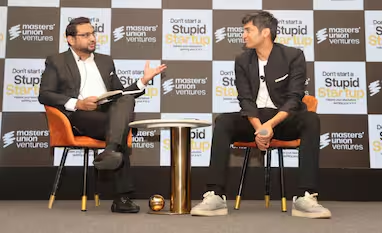
Twenty-five student-led startups have secured around ₹60.5 crore in soft funding commitments at the first Masters’ Union Ventures Demo Day in Bengaluru. More than 65 venture capital firms and angel investors participated, with startups spanning AI, climate technology, space-tech, biotech, consumer businesses and advanced manufacturing.
Bengaluru Demo Day Draws Strong Investor Interest
Student startups secured ₹60.5 crore in soft funding commitments at the Masters’ Union Ventures Demo Day held at Startup Park in Bengaluru. The event brought young founders directly in front of more than 65 venture capital firms and angel investors.
The commitments were made within about an hour of the founders’ pitches, according to reports on the September 22 event. A total of 25 startups presented their businesses, including 15 from the Masters’ Union ecosystem and 10 from external campuses.
The event is significant because the participating founders are building companies while still at a relatively early stage of their entrepreneurial journeys. The businesses covered a wide range of sectors, showing that student entrepreneurship is moving beyond conventional software and consumer internet ideas.
However, the ₹60.5 crore figure represents soft commitments, not money that has already been transferred to the startups.
What the ₹60.5 Crore Funding Commitments Mean
The distinction between funding commitments and completed funding is important.
A soft commitment indicates that investors have expressed an intention to invest following discussions or pitches. Before the money reaches a startup, investors may still conduct due diligence, negotiate valuations and investment terms, complete documentation and satisfy other conditions.
As a result, the final amount actually raised by the 25 startups may be different from the ₹60.5 crore announced at the Demo Day. Business Standard specifically noted that the commitments should not be treated as completed investment transactions.
For the founders, however, receiving commitments from investors can provide an early indication of market and investor interest. It can also give startups access to capital conversations at a stage when many young companies are still validating their products, customers and business models.
The event therefore offers a snapshot of where early-stage investors are currently seeing opportunities among young founders.
AI, Climate and Space-Tech Attract Investor Attention
The startups presenting at the Bengaluru Demo Day operated across several emerging sectors.
Artificial intelligence, climate technology, space technology, biotechnology, consumer businesses and advanced manufacturing were among the areas represented. This sectoral mix reflects the increasing breadth of India’s early-stage startup ecosystem.
Some of the startups receiving higher funding commitments included Sanyark, Saubha Aerial Systems and CarbonM.
Sanyark is developing a low Earth orbit based navigation and communication satellite constellation. Saubha Aerial Systems works on hardware solutions for autonomous drone operations, while CarbonM is developing technology to convert inconsistent waste inputs into usable fuel through pyrolysis.
These businesses illustrate the different types of problems being targeted by student founders. Instead of focusing only on consumer applications, some are working on areas involving physical infrastructure, climate solutions, aerospace and industrial technology.
Masters’ Union Ventures Focuses on Young Founders
The Demo Day was organised by Masters’ Union Ventures, a ₹100 crore early-stage fund focused on founders below the age of 25.
The fund’s investment approach is built around supporting young entrepreneurs at an early stage, when companies may still be developing their products, testing customer demand and establishing their business models.
At the Bengaluru event, 15 of the 25 participating startups came from the Masters’ Union ecosystem, while 10 came from external campuses. This external participation allowed the event to bring together founders from beyond a single institution.
More than 65 venture capital firms and angel investors attended, including Entrepreneurs First, Kae Capital, Avaana Capital, Beenext and Rainmatter. Their participation gave student founders an opportunity to present directly to investors who typically evaluate early-stage businesses.
Venture Initiation Programme Supports Student Startups
A significant portion of the startups at the event was connected to Masters’ Union’s Venture Initiation Programme, or VIP.
According to information released around the Demo Day, 60% of the participating startups were built through the programme. VIP is designed to take students through stages including problem discovery, market testing, product development, customer acquisition and investor preparation.
The programme combines entrepreneurship with students’ academic journey. Participants work on businesses while receiving access to founders, operators, mentors, investors and faculty.
Masters’ Union said its Venture Initiation Programme and related entrepreneurship initiatives have supported more than 80 student startups since inception. It also said 50 VIP-incubated startups have collectively raised more than ₹320 crore and are projected to generate over ₹530 crore in revenue by FY27.
These figures are programme-level claims and should be distinguished from the ₹60.5 crore in soft commitments announced at the latest Demo Day.
Student Founders Are Moving Into Deeptech
The sectors represented at the Bengaluru event also highlight a broader development in India’s startup ecosystem: young founders are increasingly experimenting with deeptech and technology-intensive businesses.
Space technology, autonomous drones, climate technology and biotechnology generally require different forms of capital and longer development cycles than many consumer internet businesses.
For student founders, this can create an additional challenge. Building a hardware or deeptech product can require specialised equipment, technical expertise, testing infrastructure and regulatory approvals before a commercial product can reach customers.
At the same time, these sectors can attract investors looking for businesses addressing large industrial or infrastructure problems.
The participation of startups such as Sanyark, Saubha Aerial Systems and CarbonM indicates that student entrepreneurship is not restricted to low-cost digital products.
Bengaluru Remains a Key Startup Funding Hub
The choice of Bengaluru for the Demo Day also reflects the city’s continuing role in India’s startup and venture capital ecosystem.
The city has a large concentration of technology companies, founders, investors and startup support organisations. Holding a student-focused fundraising event there gives young entrepreneurs access to a broader network of investors and operators.
For founders from smaller cities and campuses, such events can also provide a route into India’s larger startup network without requiring them to build those connections entirely on their own.
This matters as startup activity increasingly spreads beyond traditional metropolitan technology companies. Student founders are emerging from different educational institutions, while investors are evaluating opportunities across sectors such as AI, climate technology, manufacturing and space.
The Bengaluru event provides one example of how those networks are being connected at an early stage.
Demo Day Also Included AI and Founder Education
The event was not limited to investor pitches.
An AI hackathon was organised with Qualcomm Developer, allowing participants to explore practical applications of artificial intelligence and build solutions using emerging AI tools.
Masters’ Union Ventures also launched a guidebook titled “Don’t Start a Stupid Startup”, focused on helping aspiring founders evaluate and validate business ideas before leaving full-time employment.
The combination of fundraising, startup building and practical education reflects a shift in how entrepreneurship programmes are being structured. Rather than focusing only on pitching, programmes increasingly emphasise customer validation, product development and understanding whether an idea has a viable market.
For student founders, these steps can be particularly important because early enthusiasm for an idea does not necessarily translate into a sustainable business.
What Comes Next for the Funded Startups
The next stage for the 25 startups will be converting investor interest into completed transactions and using any capital raised to build their businesses.
For early-stage companies, funding is generally only one part of the process. Startups must demonstrate customer demand, manage cash carefully, develop products and establish repeatable business models.
The ₹60.5 crore commitment figure also cannot be used to determine the eventual success of the companies. The amount actually invested, the valuations agreed upon and the performance of the businesses over the following years will provide a clearer picture.
For now, the Bengaluru Demo Day shows that investors are willing to evaluate student-founded businesses across a broad range of industries, including several technology-intensive sectors.
Key Takeaways
- 25 student-led startups secured around ₹60.5 crore in soft funding commitments at the Bengaluru Demo Day.
- More than 65 venture capital firms and angel investors participated in the event.
- Startups presented businesses across AI, climate technology, space-tech, biotech, consumer businesses and advanced manufacturing.
- The ₹60.5 crore represents soft commitments and should not be treated as completed funding until investment processes are concluded.
FAQs
How much funding did the student startups secure?
The 25 student-led startups received around ₹60.5 crore in soft funding commitments during the Masters’ Union Ventures Demo Day in Bengaluru. These are investor commitments rather than completed funding transactions.
Which sectors attracted investors at the Demo Day?
The participating startups worked across artificial intelligence, climate technology, space technology, biotechnology, consumer businesses and advanced manufacturing.
Does ₹60.5 crore mean the startups have already received the money?
No. The ₹60.5 crore represents soft funding commitments. Investors may still need to complete due diligence, negotiate terms and valuations, sign investment documents and complete the transactions before the capital is actually invested.
What is Masters’ Union Ventures?
Masters’ Union Ventures is a ₹100 crore early-stage fund focused on backing founders below the age of 25. Its Demo Day provides student founders with an opportunity to present their businesses directly to venture capital firms and angel investors.









Leave a comment