

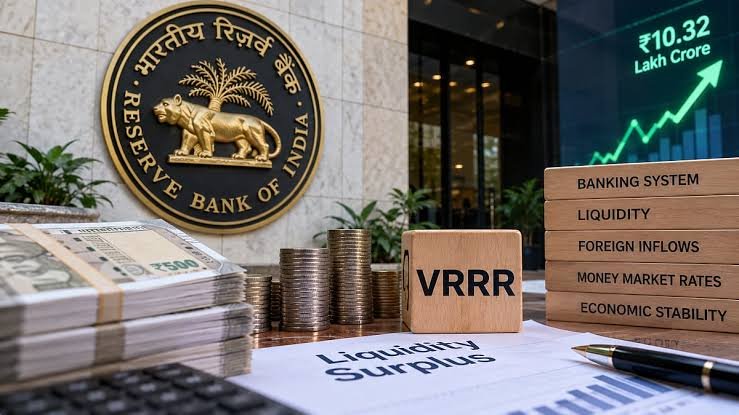
India’s banking system is seeing a sharp reduction in excess liquidity as the Reserve Bank of India steps up measures to absorb surplus cash. RBI bond sales, reverse repo operations and foreign exchange interventions have helped bring the liquidity surplus down from record levels, while keeping money-market rates closer to the policy rate.
RBI Liquidity Measures Bring Surplus Down
The Reserve Bank of India has intensified efforts to reduce excess liquidity in the banking system after surplus cash reached unusually high levels earlier this month.
According to recent market data, surplus banking system liquidity fell to around ₹4.92 lakh crore on September 21, down about 55% from the record ₹11.16 lakh crore recorded roughly two weeks earlier. The sharp decline followed a combination of RBI operations and other factors that naturally absorbed cash from the financial system.
The RBI has been using several tools rather than relying on a single operation. These include open market operations, variable rate reverse repo auctions and foreign exchange transactions.
The objective is to ensure that excess liquidity does not push overnight money-market rates too far below the RBI’s policy rate. Maintaining an effective transmission of monetary policy is particularly important when the central bank is assessing economic and inflation conditions.
Why India’s Banking System Had So Much Cash
The recent liquidity surplus was linked primarily to large foreign currency inflows under the RBI’s special FCNR(B) deposit mobilisation scheme.
Indian banks attracted a much larger amount of foreign currency deposits than initially expected. Reports indicate that lenders raised around $133 billion through the diaspora deposit scheme. The subsequent conversion and swap operations increased rupee liquidity in the banking system.
The scale of the inflows created a situation where banks had considerably more funds available than they immediately needed.
Other temporary factors also affected liquidity. Government spending, tax flows and changes in currency circulation can add or remove liquidity from the banking system depending on the timing of payments and withdrawals.
This made liquidity management an important issue for the RBI during September.
Open Market Operations Help Absorb Surplus Cash
One of the RBI’s major responses has been the use of open market operation, or OMO, sales.
Under an OMO sale, the RBI sells government securities to banks and other market participants. Buyers pay for those securities, which effectively removes rupee liquidity from the banking system.
The central bank announced OMO sales worth ₹1 lakh crore in September, divided into three tranches. It sold ₹50,000 crore of government securities in the first tranche on September 17 and another ₹25,000 crore in the second tranche on September 21. A further ₹25,000 crore operation is scheduled for September 28.
The second auction attracted bids worth ₹84,942 crore against the notified amount of ₹25,000 crore, highlighting strong demand for the securities being offered.
These operations are aimed at removing more durable liquidity from the financial system.
VRRR Auctions Target Short-Term Liquidity
The RBI has also used variable rate reverse repo, or VRRR, operations to absorb shorter-term surplus funds.
In a VRRR auction, banks temporarily park money with the RBI in exchange for interest. This reduces the amount of cash circulating within the banking system for the duration of the operation.
On September 19, the RBI absorbed ₹2.23 lakh crore through a VRRR auction after receiving bids worth ₹2,22,629 crore. The weighted average rate was 5.24%.
Earlier, on September 17, the central bank had absorbed about ₹2.39 lakh crore through another VRRR operation as banking system liquidity remained elevated.
The distinction between these tools matters. OMO sales are generally used to address more durable liquidity, while VRRR operations can manage temporary excess funds.
Money Market Rates Move Closer to RBI Policy Rate
The reduction in surplus liquidity has already affected overnight money-market conditions.
The weighted average call rate, or WACR, is an important indicator because it represents the rate at which banks lend and borrow funds in the overnight market. It also serves as the operating target for the RBI’s monetary policy framework.
Recent data showed the WACR moving closer to the repo rate as liquidity was withdrawn. Business Standard reported that the WACR settled at 5.24% on September 21, compared with 4.92% previously.
On September 23, the Economic Times reported that the WACR had moved above the repo rate to 5.31% as banking-sector liquidity contracted further, with the surplus falling below ₹5 lakh crore.
This movement is significant because excessive liquidity can keep short-term market rates below the policy rate, potentially weakening the transmission of monetary policy.
What Excess Liquidity Means for Banks
For banks, surplus liquidity can create both opportunities and challenges.
Banks with large cash balances can deploy those funds into loans, government securities or other eligible assets. However, if the banking system has too much cash at the same time, competition for lending opportunities can intensify.
The RBI has reportedly cautioned banks against aggressively reducing lending rates or loosening credit standards simply because liquidity is abundant. The concern is that banks could chase loan growth to generate returns on deposits and other funding costs, potentially increasing credit risks later.
For borrowers, easier liquidity can support credit availability. But the eventual impact on loan rates depends on several factors, including the policy rate, banks’ funding costs, deposit growth, credit demand and competition.
Why the RBI Is Watching Inflation and the Rupee
The RBI’s liquidity management is also taking place against a wider macroeconomic backdrop.
Large excess cash balances can contribute to stronger credit and financial activity if banks rapidly deploy the funds. At the same time, sustained liquidity conditions can influence money-market rates and the broader transmission of monetary policy.
Reuters reported that the recent liquidity surplus had fallen sharply following RBI action, while excess cash had raised concerns about inflationary pressures at a time when oil prices and the rupee were also being closely watched.
The central bank therefore has to balance liquidity conditions with its broader responsibilities, including price stability and orderly functioning of financial markets.
What It Means for Depositors and Borrowers
For ordinary bank customers, the RBI’s liquidity operations are unlikely to create an immediate, uniform change in loan or deposit rates.
Home-loan, personal-loan and business-loan rates depend on the individual bank’s lending benchmark and funding conditions. Deposit rates similarly depend on how banks manage their funding requirements and competition for deposits.
However, sustained changes in system liquidity can influence banks’ behaviour over time.
For small businesses and borrowers in Tier-2 and Tier-3 cities, this is particularly relevant because credit availability can affect working capital, equipment purchases, housing demand and expansion plans.
If banks face less excess liquidity and stronger competition for deposits or lendable funds, their approach to pricing credit may gradually change.
RBI’s Next Steps Remain Important
The RBI’s liquidity-management programme is still developing. The central bank has already completed major OMO and VRRR operations, but market conditions can change quickly because government spending, tax payments, currency circulation, foreign exchange flows and bank deposits continuously affect system liquidity.
The RBI has also been using foreign exchange operations alongside bond sales and liquidity absorption measures. According to Reuters, bankers attributed much of the recent decline in surplus liquidity to the central bank’s bond sales and foreign exchange interventions, along with advance-tax and GST-related outflows.
The next OMO tranche scheduled for September 28 will therefore be closely watched by banks, bond-market participants and economists.
The broader objective remains to bring liquidity conditions to a level where the RBI’s policy signals are transmitted effectively without creating unnecessary disruption in money markets.
Key Takeaways
- RBI measures have reduced banking-system surplus liquidity substantially from its September peak.
- The central bank is using OMO sales and VRRR auctions to absorb different components of excess liquidity.
- Large FCNR(B) inflows were a major reason behind the earlier surge in banking-system cash.
- Changes in liquidity can eventually influence money-market rates, bank funding conditions and credit pricing.
FAQs
What is excess liquidity in the banking system?
Excess liquidity refers to funds available with banks beyond what they immediately need for lending, settlement and other operational requirements. Banks can park surplus funds with the RBI or deploy them into eligible financial assets.
Why is the RBI reducing excess liquidity?
The RBI is managing liquidity to keep short-term money-market rates aligned with its monetary policy framework and to ensure that its policy signals are transmitted effectively through the financial system.
How does an OMO sale reduce liquidity?
During an OMO sale, the RBI sells government securities to market participants. Buyers pay the RBI for those securities, which removes an equivalent amount of rupee liquidity from the banking system.
Will RBI liquidity operations immediately change loan rates?
Not necessarily. Loan rates depend on several factors, including the RBI’s policy rate, banks’ funding costs, deposit rates, credit demand and competition. Liquidity conditions can influence these factors over time but do not automatically produce an immediate change in every bank’s lending rate.











Leave a comment