

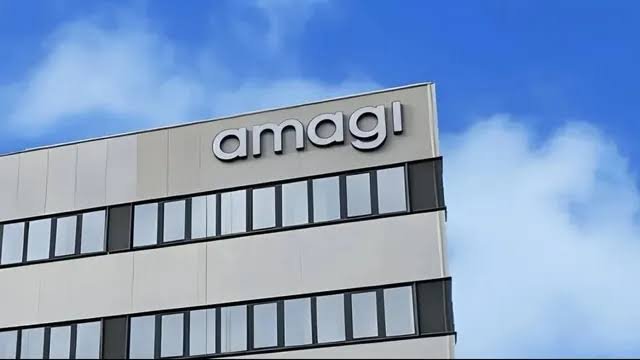
Amagi Media Labs is in focus after a ₹587 crore block deal involving about 4.85% of the company’s equity on August 21. The transaction comes shortly after strong Q1 FY27 results, putting India’s media-tech and cloud-based broadcasting sector under renewed investor attention.
Amagi Media Labs shares rise after block deal
Amagi Media Labs shares gained attention in Friday’s trading session after 1.05 crore shares, representing around 4.85% of the company’s equity, changed hands in a block deal worth approximately ₹587 crore.
The transaction took place at ₹560 per share, according to market reports. The stock was trading higher during morning trade on August 21, with Moneycontrol reporting a gain of more than 7% at one point.
The development follows reports that existing investors Trudy Holdings, AVP I Fund and Accel were looking to sell shares worth around ₹600 crore. The proposed transaction had been reported at a floor price of ₹550 per share, while the eventual block transaction was reported at ₹560 per share.
The immediate market movement is notable, but the transaction itself does not represent fresh capital being raised by Amagi. A block deal involving existing shareholders generally represents a transfer of shares between investors rather than money flowing directly into the company’s business.
Existing investors are part of the transaction
The block deal has brought Amagi’s shareholder structure into focus. NDTV Profit reported that Trudy Holdings held a 3.56% stake as of June, while Accel Growth VI Holdings held 4.31% and Accel India VI held 8.17%.
The reported sellers are established investors that participated in Amagi’s growth before and around its public-market journey. Their stake sale therefore needs to be viewed separately from the company’s operating performance.
The reported transaction also includes a 90-day lock-in period for further sales by the sellers. This means the investors involved would face restrictions on additional selling for the specified period following the transaction.
For investors tracking newly listed technology companies, such transactions can provide information about shareholder activity and market liquidity. However, a stake sale by an existing investor does not by itself establish whether the underlying company is performing well or poorly.
Amagi enters a new phase after its IPO
Amagi Media Labs made its stock market debut in January 2026. Its initial public offering raised ₹816 crore through the fresh issue, while existing shareholders offered shares worth about ₹973 crore through the offer-for-sale component. The IPO was priced in the ₹343 to ₹361 range.
The company is headquartered in Bengaluru and operates in media technology, providing cloud-based software and services for broadcasters, content owners and streaming platforms.
Its technology is designed to support areas such as content creation, distribution, monetisation and broadcast operations across traditional television, connected TV and streaming platforms. The company has said it works with more than 45% of India’s top 50 listed media and entertainment companies by revenue.
That business model places Amagi within a broader shift in the media industry, where broadcasters and content companies are moving more operations to cloud infrastructure while simultaneously expanding across streaming and connected-TV platforms.
Strong Q1 results provide important context
The block deal comes shortly after Amagi reported its Q1 FY27 financial results for the quarter ended June 30, 2026.
The company reported revenue of ₹437 crore, representing 32.4% year-on-year growth and its highest quarterly revenue to date. Adjusted EBITDA increased 201% year on year to ₹50 crore, while adjusted EBITDA margin expanded to 11.5%. Profit after tax increased 760% to ₹34 crore from ₹4 crore in Q1 FY26.
Amagi also reported cash, investments and bank balances of ₹1,616 crore at the end of June, with zero debt. The company attributed the quarter’s performance to customer expansion and continued adoption of cloud-native streaming, monetisation and broadcast workflows.
The strong quarterly numbers help explain why the company has remained on the radar of investors following its listing. At the same time, one strong quarter does not by itself establish a long-term trend, particularly for a recently listed technology company.
AI becomes part of Amagi’s growth strategy
Artificial intelligence is another factor attracting attention to Amagi’s business.
The company has been increasing its focus on AI-led products and recently announced a customer for its NEWSPULSE platform, which is designed to support AI-driven newsroom transformation. Amagi said it had more than 10 active AI pilots with news organisations globally as of its Q1 FY27 update.
Moneycontrol reported that Amagi sees AI as an important component of its next growth phase. The company is also looking at increasing cloud adoption and streaming consumption as drivers for its longer-term expansion.
This places Amagi within a larger technology trend affecting broadcasters and media companies. AI is increasingly being explored for newsroom workflows, content operations, localisation, distribution and other parts of the media supply chain.
For media businesses, the attraction is not simply automation. Cloud and AI tools can potentially help organisations manage growing volumes of content across television, streaming services and digital platforms.
India remains an important growth market
Although Amagi operates globally, India is one of the markets management expects to become more important over time.
Moneycontrol reported that the United States currently accounts for nearly 73% of Amagi’s revenue, while the company expects India’s contribution to increase as cloud adoption and streaming consumption grow. Management also indicated that existing customer expansion in India is currently in the single digits.
This creates an interesting opportunity as India’s media consumption becomes increasingly fragmented across television, smartphones, connected TVs and streaming platforms.
The shift is particularly relevant beyond major metropolitan areas. Regional-language content, local broadcasters and digital-first media businesses are expanding their reach across Tier-2 and Tier-3 markets. As audiences move between television and digital platforms, media companies need technology that can manage content distribution across several channels.
For media-tech companies, this creates a potential long-term market opportunity, although the pace of adoption will vary by customer and region.
What the block deal means for investors
The ₹587 crore transaction is significant because it involves a meaningful portion of Amagi’s equity, but it should not be interpreted as a direct funding round.
Fresh funding goes into a company when it issues new shares or raises debt. In a secondary block deal, existing shareholders transfer their shares to other investors. The company generally does not receive the transaction proceeds.
The deal can, however, increase the amount of Amagi stock available to institutional and other investors. It can also affect short-term trading volumes and investor sentiment.
The transaction is particularly notable because Amagi’s stock has experienced considerable movement since its January listing. NDTV Profit reported that the shares had gained 64.82% year to date as of August 20, despite declines over the preceding week and month.
That volatility means investors are likely to watch both shareholder activity and the company’s operating performance closely.
Media-tech sector faces a larger technology shift
Amagi’s latest developments also highlight the changing economics of the media technology industry.
Traditional broadcasters once relied heavily on fixed infrastructure and distribution systems. Today, media companies increasingly need cloud platforms that can support streaming, connected television, advertising, content delivery and multiple digital formats.
The growth of FAST channels, connected TV and streaming services has expanded the number of platforms through which content can reach audiences. This creates additional technology requirements for media companies, from content management and distribution to monetisation.
AI adds another layer to this transition. Media organisations are now exploring how AI can assist with newsroom operations, content workflows and other repetitive processes.
Amagi’s business sits within this intersection of cloud technology, media distribution and AI. Its recent financial performance suggests strong operating momentum, while the block deal shows that existing investors are also actively managing their positions.
What comes next for Amagi Media Labs
The immediate focus will likely remain on how Amagi converts its recent revenue growth into sustained profitability and cash generation.
The company has reported strong Q1 FY27 numbers and increased its emphasis on AI and cloud-based media infrastructure. At the same time, its large exposure to international markets means currency movements, global media spending and technology investment cycles remain relevant factors.
The upcoming investor meetings scheduled for late August could provide further insight into the company’s strategy and market outlook.
For India’s media-tech sector, the larger takeaway is that cloud infrastructure, streaming and AI are becoming increasingly connected. Amagi’s latest block deal has brought the company back into market focus, but its longer-term significance will depend on business execution, customer expansion and the ability to build sustainable growth.
Key Takeaways
- Amagi Media Labs saw a ₹587 crore block deal involving about 4.85% of its equity on August 21.
- Trudy Holdings, AVP I Fund and Accel were reported among the investors involved in the stake sale.
- Amagi reported record Q1 FY27 revenue of ₹437 crore and a 760% year-on-year rise in PAT to ₹34 crore.
- Cloud adoption, streaming, connected TV and AI are emerging as key areas shaping Amagi’s future growth strategy.
FAQ
What happened in Amagi Media Labs on August 21, 2026?
Around 1.05 crore Amagi Media Labs shares, representing approximately 4.85% of the company’s equity, changed hands in a block deal valued at about ₹587 crore. The transaction was reported at ₹560 per share.
Does the block deal give fresh money to Amagi Media Labs?
No. The transaction involves existing shareholders selling shares to other investors. Unlike a fresh share issue, the proceeds from a secondary block deal do not generally go directly to Amagi’s balance sheet.
How did Amagi perform in Q1 FY27?
Amagi reported revenue of ₹437 crore in Q1 FY27, up 32.4% year on year. Adjusted EBITDA rose 201% to ₹50 crore, while profit after tax increased 760% to ₹34 crore.
Why is AI important to Amagi’s business?
Amagi is expanding its focus on AI-powered media technology, including its NEWSPULSE product for newsroom transformation. The company said it had more than 10 active AI pilots with news organisations globally as part of its Q1 FY27 update.
(Internal keywords: Amagi Media Labs block deal, Amagi shares today, Amagi Media Labs latest news, Amagi ₹587 crore block deal, Amagi investor stake sale, India media-tech sector, media technology companies India, Amagi Q1 FY27 results, AI media technology India, cloud media technology, Indian streaming technology, connected TV India)









Leave a comment