

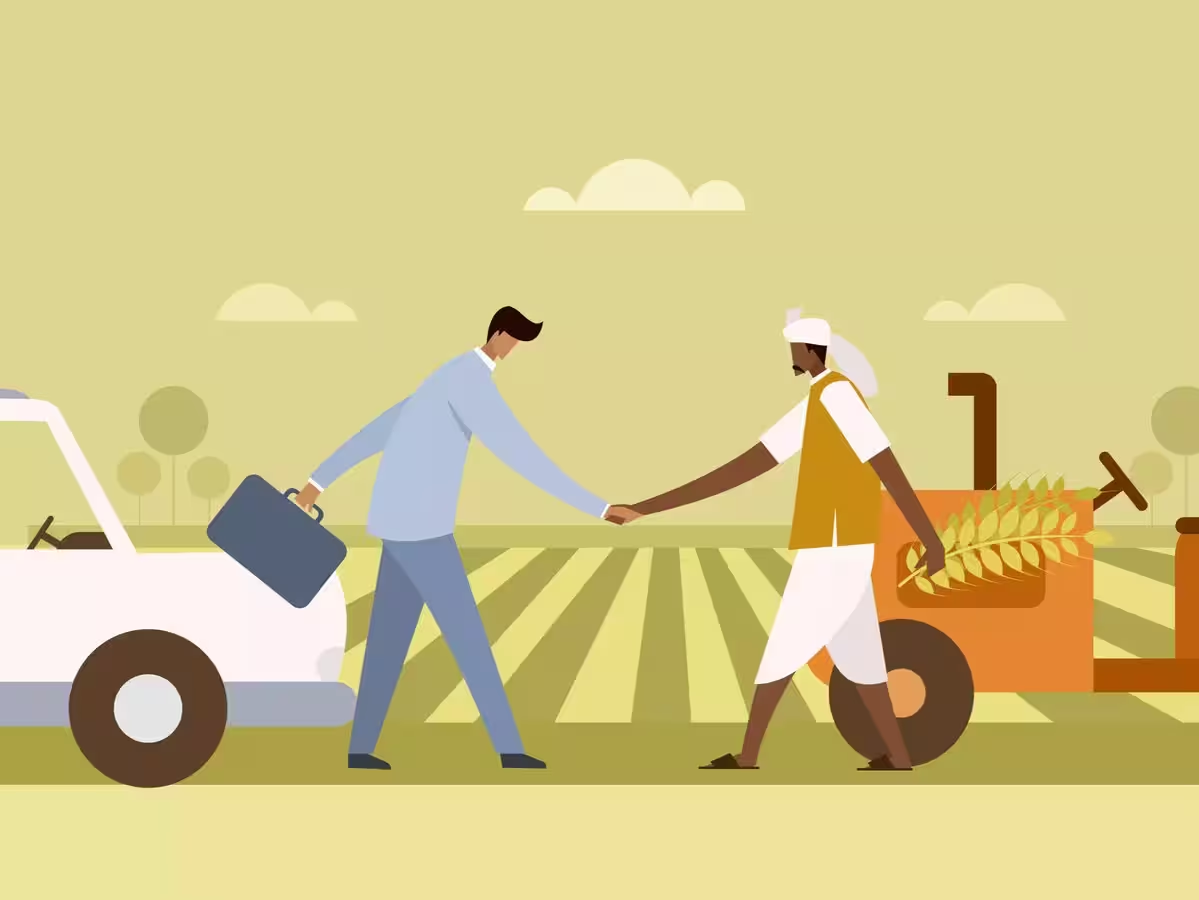
India’s business growth is increasingly reaching Tier-2 and Tier-3 cities as digital adoption, infrastructure investment, rising incomes and lower operating costs encourage companies to expand beyond traditional metropolitan hubs. The shift is reshaping consumption, employment, startups, real estate and financial services.
Smaller cities are becoming new business centres
India’s business growth is no longer concentrated only in Mumbai, Delhi-NCR, Bengaluru, Hyderabad and other major metropolitan markets. Over the past few years, Tier-2 and Tier-3 cities have increasingly emerged as important centres for consumption, employment, entrepreneurship and investment.
Recent data across sectors points to the same broader trend. Smaller cities accounted for nearly 66% of new direct-to-consumer orders in FY26, while Tier-2 and Tier-3 markets contributed 64% of India’s home loan volumes in 2025.
The change is not simply about consumers buying more products online. Companies are also establishing offices, warehouses, manufacturing units, service centres and distribution networks in cities where costs can be lower and local demand is expanding.
This is gradually creating a more distributed business ecosystem across India.
Digital adoption is reducing the metro advantage
One of the biggest reasons businesses can expand into smaller cities is the wider availability of digital infrastructure.
Internet access, smartphones, UPI payments, online marketplaces, cloud services and digital lending have reduced some of the traditional barriers faced by businesses operating outside large urban centres.
A small retailer in a district headquarters can now reach customers through digital commerce platforms. A local entrepreneur can accept digital payments, advertise through social media and access business services without maintaining a physical presence in a metro.
For larger companies, the same infrastructure makes it easier to manage employees, customers and operations across multiple locations.
The result is a business environment where geographical distance matters less for several types of services than it did a decade ago.
Tier-2 and Tier-3 cities are driving consumer demand
Consumer markets are among the clearest examples of this shift.
According to Unicommerce data reported in April, Tier-2 and Tier-3 cities generated nearly 66% of new D2C orders in FY26. Overall D2C order volumes increased 33%, while gross merchandise value rose 32%.
This suggests that smaller-city consumers are becoming increasingly important to brands selling fashion, beauty, electronics, home products and other categories online.
The growth also changes how companies think about market expansion. Instead of treating smaller cities as secondary markets, brands increasingly need dedicated strategies for local demand, pricing, logistics and regional-language communication.
This is particularly relevant for Indian businesses because consumer preferences can differ significantly between cities and states.
Infrastructure is creating new economic opportunities
Physical infrastructure is another major factor behind the expansion.
Investments in airports, highways, expressways, industrial corridors, rail connectivity, urban transport and digital networks can make smaller cities more attractive to companies.
Recent reporting has highlighted the expansion of businesses and real estate developers into Tier-2 markets because of improving infrastructure, industrial activity, land availability and changing consumer preferences.
The Union Budget 2026 also placed a specific emphasis on developing Tier-II and Tier-III cities through City Economic Regions. The government announced ₹5,000 crore over five years for each selected city economic region under a challenge-based, results-linked framework.
If these investments translate into better transport, utilities and employment infrastructure, they can make smaller cities more viable locations for businesses.
Companies are following talent beyond metros
Cost is important, but talent availability is equally significant.
Large metropolitan cities continue to offer deep talent pools, but high rents, expensive housing, traffic congestion and rising employee costs can make expansion increasingly expensive.
Companies are therefore exploring locations where they can access skilled workers at comparatively lower costs.
A July report by Business Standard, citing LinkedIn’s Cities on the Rise data, identified 10 non-metro cities among India’s fastest-growing job markets. Visakhapatnam, Ludhiana, Surat, Vadodara and Prayagraj were among the cities highlighted.
The trend is visible across sectors. Technology companies, BFSI firms and flexible workspace operators have shown increasing interest in Tier-2 cities for office expansion. Office leasing activity in these markets nearly doubled year on year in FY25, according to a Business Standard report.
This creates a reinforcing cycle: more companies create more jobs, and more jobs attract workers and consumers.
Startups are also moving beyond traditional hubs
India’s startup ecosystem is undergoing a similar geographical shift.
Bengaluru, Mumbai and Delhi-NCR remain major startup centres, but entrepreneurs are increasingly building companies from smaller cities.
The reasons are practical. Operating costs can be lower, local problems can provide opportunities for specialised businesses, and digital infrastructure allows founders to serve customers across the country.
Business Standard reported in July that more than half of India’s registered startups originate from Tier-2 and Tier-3 cities, with businesses emerging across SaaS, manufacturing, logistics, agritech and AI-enabled services.
This matters because startup activity can create an ecosystem beyond the companies themselves. New businesses generate demand for accountants, lawyers, marketers, technology providers, logistics companies, coworking spaces and financial services.
Over time, that can make a smaller city more commercially diverse.
Housing finance shows the shift in purchasing power
The expansion is also visible in financial services.
Tier-2 and Tier-3 cities recorded 81% year-on-year growth in home loan volumes in 2025, compared with 52% growth in Tier-1 cities, according to a report cited by Business Standard. These markets accounted for 64% of total home loan volumes during the year.
The numbers indicate growing demand from first-time and middle-income homebuyers outside the largest metropolitan markets.
For banks, housing finance companies and fintech platforms, this creates a larger addressable market. It also creates demand for related businesses such as insurance, home improvement, construction materials, brokerage and financial advisory services.
However, the housing story is not uniformly positive. Another 2026 report found that housing sales in the top 15 Tier-2 cities declined 10% in 2025, partly because affordability pressures and premiumisation were reducing the supply of homes below ₹1 crore.
That contrast is important. Smaller-city growth is real, but it does not mean every sector or every city is expanding at the same pace.
E-commerce is making smaller markets more attractive
The growth of online commerce has further changed the economics of reaching non-metro customers.
India’s e-commerce expansion is increasingly linked to consumers in smaller cities and towns. Reuters reported this week that India’s online retail gross merchandise value is expected to grow at a 20% to 25% compound annual rate between 2025 and 2030, with rising internet penetration, digital payments and demand from smaller cities among the factors supporting growth.
Logistics companies are responding by expanding their networks, while brands are investing in regional distribution and digital customer acquisition.
The growth of quick commerce is another part of this wider retail transition. An Equirus report cited by The Economic Times estimated India’s digital commerce market at ₹8 lakh crore in 2026, with quick commerce expected to reach ₹1.08 lakh crore and grow at 40% year on year. The report also highlighted increasing adoption in Tier-II and Tier-III cities.
As logistics improve, businesses can serve markets that were previously difficult or expensive to reach.
Why Tier-2 cities matter to BFSI businesses
The shift has particular significance for India’s banking, financial services and insurance industry.
As businesses and households outside metros become more active participants in the formal economy, demand can increase for bank accounts, credit, insurance, wealth products, payment solutions and business financing.
The growth of home loans in smaller cities already demonstrates the opportunity. Digital onboarding and fintech-led distribution can further reduce the cost of reaching customers in locations where traditional branch expansion may be expensive.
The same applies to small businesses. A retailer, manufacturer or service provider in a Tier-2 city may need working capital, equipment finance, insurance and payment solutions as the business grows.
For BFSI companies, the opportunity is therefore not limited to acquiring individual customers. It extends to financing the broader economic activity developing around these cities.
Challenges could determine whether growth lasts
The shift beyond metros does not mean smaller cities are ready for unlimited expansion.
Infrastructure quality remains uneven. Some cities continue to face shortages in public transport, affordable housing, healthcare, water supply, waste management and urban planning. Rapid business and population growth can put additional pressure on these systems.
Talent availability can also become a constraint as companies expand.
Another issue is affordability. Rising property prices in successful Tier-2 markets can eventually reduce one of their biggest advantages over metros.
This means businesses need to look beyond lower costs when selecting new locations. Connectivity, skilled workers, local demand, infrastructure quality and long-term urban planning will increasingly determine which cities can sustain economic growth.
India’s next business map could be more distributed
The growth of Tier-2 and Tier-3 cities is better understood as a gradual redistribution of economic activity rather than a replacement of metropolitan India.
Mumbai, Bengaluru, Delhi-NCR and Hyderabad will continue to play major roles in finance, technology, corporate services and large-scale business. But smaller cities are increasingly taking on specialised roles in manufacturing, logistics, retail, services, technology and regional consumption.
Cities such as Surat, Visakhapatnam, Nagpur, Jaipur, Coimbatore, Indore, Lucknow and Vadodara illustrate how different growth models can emerge outside the traditional metro framework.
For businesses, this creates a larger Indian market with more geographic diversity. For investors, it creates new opportunities but also requires greater attention to city-level fundamentals.
The bigger shift is that India’s economic growth is becoming less dependent on a handful of metropolitan centres. Digital access, infrastructure investment, rising consumer aspirations and expanding employment are allowing more cities to participate in the country’s next phase of business growth.
Key Takeaways
- Tier-2 and Tier-3 cities are becoming important centres for consumption, employment, startups and investment.
- Smaller cities accounted for nearly 66% of new D2C orders in FY26, according to Unicommerce data.
- Infrastructure, digital payments, e-commerce and lower operating costs are helping businesses expand beyond metros.
- Growth remains uneven, with affordability, infrastructure, talent and urban planning emerging as key challenges.
FAQ
Why are businesses expanding into Tier-2 and Tier-3 cities?
Companies are looking at smaller cities because of growing consumer demand, lower operating costs, improving infrastructure, expanding talent pools and increasing digital adoption.
Which sectors are growing beyond India’s major metros?
E-commerce, D2C brands, BFSI, real estate, manufacturing, logistics, technology services and startups are among the sectors showing increasing activity in smaller cities.
Are Tier-2 cities growing faster than metros?
In some areas, yes. For example, Tier-2 and Tier-3 cities recorded faster home loan volume growth than Tier-1 cities in 2025, while smaller cities also generated a large share of new D2C orders in FY26. However, growth varies significantly by sector and city.
What could slow business growth in smaller cities?
Infrastructure gaps, limited skilled talent, rising property prices, affordability pressures and inadequate urban planning could restrict growth if cities expand faster than their infrastructure can support.
(Internal keywords: India Tier-2 cities business growth, Tier-3 cities India economy, non-metro business growth, India small city startups, Tier-2 city investment, India D2C growth, small city e-commerce India, BFSI Tier-2 cities, digital economy India, emerging business cities India)












Leave a comment