

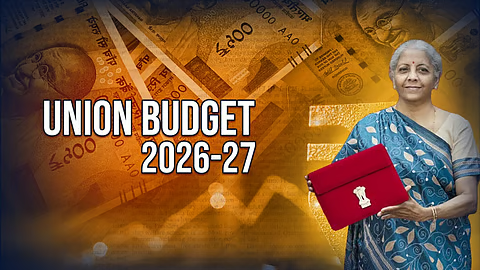
Budget 2026 vs Budget 2025 comparisons reveal that the real shifts lie beyond headline incentives and headline tax tweaks. Budget 2026 focuses more on execution depth, regional balance and structural efficiency, while Budget 2025 was largely oriented toward recovery momentum and capex continuity.
Intent and nature of the topic
This is a time-sensitive news-led comparative analysis. The tone is factual, data-driven and explanatory, focused on what has materially changed between the two budgets.
Capital expenditure strategy moves from scale to targeting
In the Budget 2026 vs Budget 2025 comparison, capital expenditure remains a core pillar but with a notable shift in intent. Budget 2025 prioritised aggressive capex expansion to sustain post-recovery growth, focusing on large national highways, railways and defence manufacturing. The emphasis was on scale and speed.
Budget 2026, by contrast, refines this approach. Instead of broad-based expansion, allocations are more targeted toward regional connectivity, logistics efficiency and urban infrastructure in Tier-2 cities. Funding is increasingly tied to project readiness, state-level execution capacity and measurable outcomes.
This change indicates a move from capex as a stimulus tool to capex as a productivity lever. Secondary keywords such as infrastructure allocation strategy and capital efficiency signal this transition.
Regional development gains sharper focus
One of the most genuine differences in Budget 2026 vs Budget 2025 is the emphasis on regional economic balance. Budget 2025 acknowledged regional development but largely through national programs. Budget 2026 explicitly channels resources toward non-metro business hubs, logistics nodes and industrial clusters.
Tier-2 cities receive focused attention through transport connectivity, industrial zoning support and urban capacity upgrades. This marks a departure from earlier approaches where benefits trickled down indirectly. The intent now is to create independent growth engines outside major metros.
This shift reflects lessons from execution data, where regional infrastructure investments showed higher marginal economic returns compared to saturated urban centres.
MSME policy shifts from relief to scalability
MSME support in Budget 2025 was primarily relief-oriented. Credit guarantees, emergency lending support and compliance relaxations were designed to stabilise businesses during uncertain demand cycles. These measures addressed survival rather than expansion.
Budget 2026 signals a change in approach. MSME allocations focus more on scalability through cluster-based manufacturing, technology adoption and market access. Credit support is increasingly linked to performance, formalisation and integration into larger supply chains.
Instead of temporary relief, the policy direction now aims to structurally upgrade MSMEs into competitive suppliers. Secondary keywords like MSME growth framework and cluster-based manufacturing highlight this evolution.
Tax policy consistency replaces one-off incentives
Tax-related announcements in Budget 2025 were characterised by selective incentives and sector-specific reliefs. While these measures provided immediate benefits, they also introduced complexity and planning uncertainty for businesses.
Budget 2026 adopts a more restrained tone on taxation. The emphasis shifts toward predictability, stability and fewer structural changes. Rather than introducing multiple new incentives, the focus is on improving administration efficiency, reducing disputes and speeding up refunds.
This approach benefits long-term planning, particularly for MSMEs and startups that operate on tight cash cycles. Predictability becomes the incentive rather than incremental rate adjustments.
Startups and innovation funding become more selective
In Budget 2025, startup policy focused on ecosystem expansion through broad-based funding programs and regulatory support. The goal was to encourage participation and experimentation across sectors.
Budget 2026 introduces greater selectivity. Innovation funding is more closely aligned with national priorities such as manufacturing technology, climate solutions and digital public infrastructure. Instead of volume-based support, funding mechanisms emphasise viability, scalability and public utility.
This reflects a maturing startup ecosystem where policy shifts from quantity to quality. Secondary keywords such as startup funding priorities and innovation-linked incentives align with this recalibration.
Urban infrastructure moves toward execution discipline
Urban development funding in Budget 2025 largely focused on expanding coverage under existing programs. Budget 2026 places greater emphasis on execution discipline, governance reforms and outcome-based funding for cities.
Allocations are increasingly tied to performance metrics such as project completion timelines, service delivery improvements and fiscal management. Cities demonstrating better execution capacity are positioned to attract more funding.
This marks a significant shift in how urban infrastructure spending is evaluated and deployed, particularly for fast-growing Tier-2 cities.
Employment and skilling policy becomes demand-linked
Budget 2025 focused on expanding skilling programs and employment schemes through increased allocations. However, outcomes often varied due to misalignment with local industry needs.
Budget 2026 introduces stronger demand linkage. Skilling initiatives are increasingly mapped to regional industry clusters and hiring incentives are tied to formal employment creation. This improves absorption rates and reduces skill mismatches.
The change indicates a move from input-based spending to outcome-oriented workforce development.
Fiscal discipline strengthens amid growth stability
A subtle but important change in Budget 2026 vs Budget 2025 is fiscal posture. Budget 2025 balanced growth support with fiscal consolidation cautiously. Budget 2026 reflects greater confidence in growth stability, allowing tighter expenditure prioritisation without sharp cutbacks.
This strengthens macroeconomic credibility while maintaining development momentum. Fiscal discipline is achieved through better targeting rather than reduced ambition.
Takeaways
• Budget 2026 shifts focus from scale-driven spending to execution efficiency
• Regional development receives more direct and targeted support
• MSME policy evolves from survival relief to long-term scalability
• Tax and startup policies emphasise predictability and quality over volume
FAQs
What is the main difference between Budget 2026 and Budget 2025?
Budget 2026 focuses more on execution, regional balance and structural efficiency, while Budget 2025 prioritised broad-based recovery and spending momentum.
Does Budget 2026 reduce incentives compared to Budget 2025?
Not necessarily. It restructures incentives to be more targeted and outcome-driven rather than headline-heavy.
How does Budget 2026 impact MSMEs differently?
The focus shifts from emergency support to growth-oriented measures like cluster development and technology adoption.
Is Budget 2026 more fiscally conservative?
It reflects stronger fiscal discipline through better targeting, not reduced development spending.












Leave a comment