

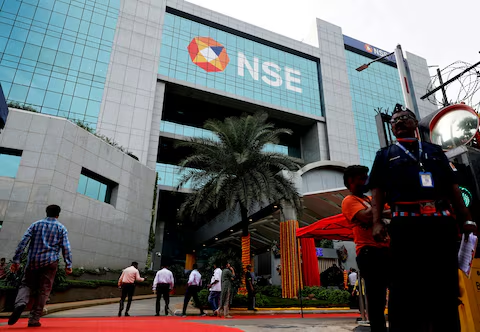
Indian markets fell to a three-month low on September 11 as Brent crude oil moved above $108 a barrel, intensifying concerns over inflation, the rupee and borrowing costs. The sell-off spread across sectors, with financial, metal, auto, small-cap and mid-cap stocks among those under pressure.
Indian stock market falls as oil prices surge
The Indian stock market came under renewed pressure on Friday as rising crude oil prices and escalating geopolitical tensions in the Middle East weighed on investor sentiment. The Nifty 50 fell 0.92% to 23,261.70, while the BSE Sensex declined 0.84% to 74,272.61, according to Reuters. Both benchmarks were at their lowest level in three months.
The decline was broad based. Fifteen of the 16 major sectors tracked in the market were lower, while small-cap and mid-cap stocks fell even more sharply. Small-cap stocks declined around 1.2% and mid-caps fell 1.4%.
The pressure has also extended the market’s recent losing streak. For the week, the Nifty 50 was down about 2.7%, while the Sensex had fallen around 2.9%, marking a fifth consecutive weekly decline.
The immediate concern is not only the fall in share prices. Investors are assessing how sustained higher crude oil prices could affect India’s inflation outlook, currency stability, company costs and economic growth.
Why Brent crude has crossed $108
The latest oil shock is being driven by worsening geopolitical conditions in the Middle East and disruptions around important shipping routes.
Brent crude climbed to around $108.96 a barrel on Friday, with prices approaching $110 during Asian trading. Reuters reported that the latest increase followed developments involving Iran-aligned Houthi forces and disruption risks around key Red Sea routes.
Oil prices had already moved sharply higher earlier in the week. Brent gained nearly 12% during the week, making crude one of the biggest concerns for emerging markets such as India.
For India, the development matters because the country depends heavily on imported crude oil. When international oil becomes more expensive, the economy needs more foreign currency to pay for energy imports. That can put pressure on the rupee and increase the cost of imported goods and raw materials.
The effect is therefore broader than petrol and diesel alone.
How higher crude affects Indian businesses
Higher crude prices can increase operating costs for companies across several industries.
Airlines are among the most directly exposed businesses because aviation turbine fuel is a major operating expense. Logistics companies and road transport operators can also face higher fuel costs, which may eventually affect freight rates and the cost of moving goods.
Manufacturers can feel the impact through transportation, packaging, chemicals and other petroleum-linked inputs. Paint, chemical, plastic and synthetic-material businesses may also face pressure when energy and petrochemical costs increase.
Auto companies can experience a different kind of impact. Higher fuel prices can influence consumer decisions, particularly for buyers considering petrol and diesel vehicles. At the same time, manufacturers and suppliers can face higher logistics and input costs.
Small businesses in Tier-2 and Tier-3 cities may be particularly sensitive to such changes because transportation represents an important part of the cost of moving inventory between manufacturers, distributors, wholesalers and retailers.
The impact, however, will not be identical across companies. Businesses with strong pricing power or lower energy exposure may be better positioned than companies operating on thin margins.
What rising oil means for consumers
For consumers, crude oil prices matter because fuel is connected to a much wider part of the household economy.
Petrol and diesel affect personal transportation, public transport, freight movement and agricultural activity. Diesel is particularly important for commercial vehicles, tractors, construction equipment and goods transportation.
That means a prolonged increase in energy costs can eventually raise expenses for businesses and households even when the initial impact is not visible at the petrol pump.
However, higher international crude prices do not automatically mean an immediate increase in retail petrol and diesel prices in India. The government has previously taken measures to cushion consumers and oil marketing companies from international price shocks.
In March 2026, the government announced a ₹10-per-litre reduction in excise duty on petrol and diesel after crude prices had surged sharply. The move was intended to reduce the burden on oil marketing companies while retail pump prices were kept unchanged.
The government also said in June that adequate petrol and diesel stocks were available across the country and advised consumers against panic buying.
Rupee comes under pressure from expensive oil
The crude oil surge is also putting pressure on the Indian rupee.
Reuters reported that the rupee weakened to around 95.79 per dollar during Friday trading before recovering slightly. Traders also reported possible intervention by the Reserve Bank of India to limit excessive volatility in the currency market.
A weaker rupee can make imported commodities more expensive. For an oil-importing economy, this creates an additional challenge because the country is effectively paying more for crude both because of the higher dollar price of oil and, potentially, because of a weaker domestic currency.
The currency effect can therefore amplify the economic impact of an oil shock.
Inflation and interest rate concerns return
The other major concern for investors is inflation.
If higher crude prices remain elevated for an extended period, businesses may eventually pass some of their higher costs to customers. This can complicate the inflation outlook and influence central banks’ decisions on interest rates.
Global bond yields have already moved higher as investors reassess inflation risks. Reuters reported that India’s 10-year government bond yield moved above 7% on Friday, reaching its highest level in more than three months.
Higher yields can make borrowing more expensive for businesses and governments. For companies, this can affect expansion plans, capital expenditure and debt-servicing costs.
For consumers, the broader effect could emerge through loan rates if higher inflation and global interest-rate expectations persist.
Not every Indian sector is losing
The market decline is broad, but higher crude prices can benefit some parts of the economy.
Energy companies with exposure to oil production can gain from stronger crude prices. On Friday, ONGC and Oil India recorded modest gains even as the wider market declined.
This creates an important distinction within the energy sector. Companies that produce crude can benefit from higher prices, while companies that depend heavily on buying petroleum products as inputs may face greater cost pressure.
Investors therefore tend to assess the impact of an oil shock on individual businesses rather than assuming that every company will be affected in the same way.
What this means for Tier-2 and Tier-3 India
The crude oil shock is not limited to Mumbai, Delhi, Bengaluru or other major financial centres.
In smaller cities and towns, higher transportation costs can affect wholesalers, retailers, manufacturers, farmers, construction businesses and local service providers.
A trader transporting goods from a distribution hub to a smaller town may face higher logistics expenses. A farmer using diesel-powered equipment may see operating costs rise. A small manufacturer may face higher freight and packaging expenses.
If the increase lasts for several months, businesses may have to decide whether to absorb the additional cost, reduce margins or pass part of it on to customers.
For consumers in Tier-2 and Tier-3 cities, the effect could therefore appear gradually through transportation and the prices of goods rather than through fuel prices alone.
Domestic investors remain an important support
Despite the market sell-off, domestic investment flows have remained relatively strong.
Data released by the Association of Mutual Funds in India showed that systematic investment plan contributions rose to a record ₹32,297 crore in August. Equity mutual fund inflows also increased 18.8% from July to ₹29,329 crore.
This suggests that many retail investors continue to invest through SIPs despite short-term market volatility.
That does not eliminate the risks created by higher crude prices, but it provides an important source of domestic liquidity when foreign and global market sentiment becomes weaker.
The key question now is how long the oil shock lasts. A temporary spike could have a limited impact, while a prolonged period of crude prices near or above current levels would create a much larger challenge for inflation, corporate margins and economic growth.
Takeaways
- Indian benchmark indices fell to three-month lows on September 11, with the Nifty 50 down 0.92% and Sensex down 0.84%.
- Brent crude moved above $108 a barrel as Middle East tensions increased concerns about global energy supplies.
- Higher crude prices can affect India’s rupee, inflation, transportation costs, corporate margins and borrowing conditions.
- Domestic SIP and mutual fund inflows remain strong, showing continued retail participation despite recent market weakness.
FAQs
Why did Indian markets fall on September 11, 2026?
Indian markets declined primarily because of rising crude oil prices, heightened Middle East tensions, pressure on the rupee and concerns about inflation and global interest rates. The Nifty 50 and Sensex both fell to three-month lows.
How does higher crude oil affect India?
India imports a large share of its crude oil requirements, so higher international prices increase the country’s import bill. Expensive oil can also put pressure on the rupee and raise costs for transportation, manufacturing and other businesses.
Will petrol and diesel prices immediately increase?
Not necessarily. International crude prices and domestic retail fuel prices do not move automatically in a one-to-one relationship. Government policy, taxes and oil marketing company pricing decisions can influence retail prices. In 2026, the government has already taken measures to cushion consumers from earlier oil-price shocks.
Which businesses are most exposed to higher crude prices?
Airlines, logistics companies, transport operators and businesses using petroleum-linked raw materials can face significant cost pressure. Oil producers can benefit from higher crude prices, so the impact varies substantially between sectors and individual companies.
(Internal keywords: Indian stock market today, Sensex today, Nifty 50 today, crude oil price India, Brent crude price, Indian markets three month low, crude oil impact on India, rupee vs dollar, India inflation, petrol diesel prices, Indian stock market news, oil prices and Indian economy, Tier-2 business India, Indian market September 2026)












Leave a comment