

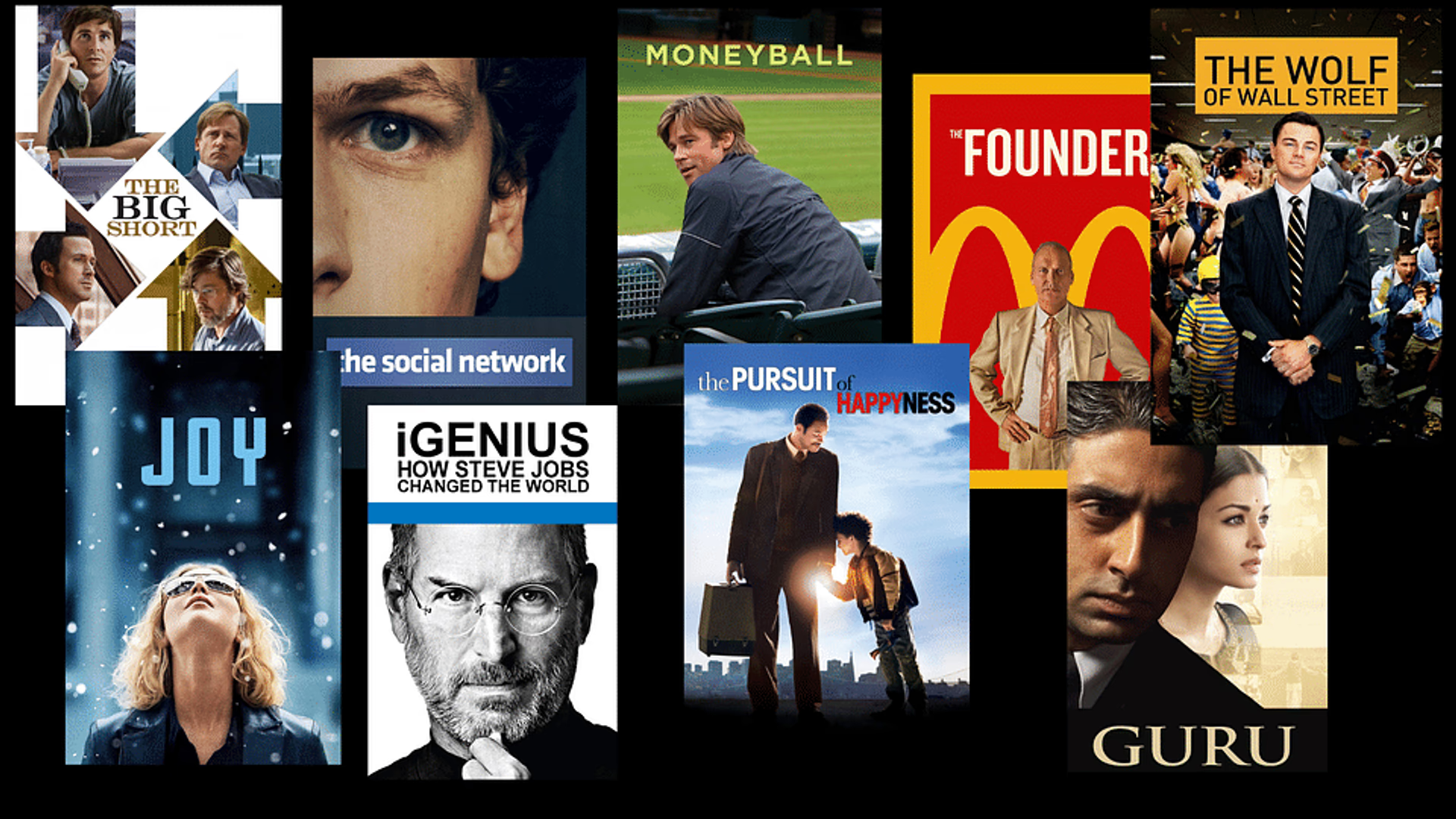
Understanding venture capital is not limited to reading finance books or startup guides. Several films and documentaries offer practical insights into fundraising, innovation, investor psychology, and entrepreneurial decision-making, making complex business concepts easier to understand for aspiring founders and investors.
Learning about venture capital often begins with books, podcasts, or startup blogs. While these resources explain investment terminology and financial models, they sometimes overlook the human side of entrepreneurship. Movies and documentaries bridge that gap by showing how founders pitch ideas, overcome failures, negotiate with investors, build teams, and make difficult business decisions. Although many films simplify real-world events for storytelling, they still provide valuable lessons about risk, innovation, leadership, and the relationship between entrepreneurs and investors. For aspiring startup founders, angel investors, and business students, these stories can make venture capital concepts more relatable than traditional textbooks.
The Social Network Shows Why Execution Matters
Released in 2010, The Social Network follows the early journey of Facebook and its founder, Mark Zuckerberg. While the film focuses on the company’s formation and legal disputes, it also highlights several principles that influence venture capital decisions.
One of the most important lessons is that investors often look beyond ideas and evaluate execution. Social networking was not a completely new concept when Facebook was launched, but the company’s rapid product development, user growth, and scalability attracted investor interest.
The film also demonstrates how startup ownership, founder relationships, equity allocation, and governance can influence a company’s future. These issues remain highly relevant in today’s venture capital ecosystem, where investors closely examine cap tables and founder agreements before investing.
Something Ventured Brings Venture Capital to Life
Few documentaries explain venture capital as effectively as Something Ventured. The film explores the rise of Silicon Valley through interviews with legendary venture capitalists who invested in companies such as Apple, Intel, Cisco, Atari, and Genentech.
Instead of focusing only on successful founders, the documentary explains how investors evaluate opportunities, manage uncertainty, and support entrepreneurs during the early stages of company building.
It also highlights an important reality about venture investing. Most startups do not become billion-dollar companies. Venture capital firms succeed because a small number of exceptional investments generate returns that offset multiple unsuccessful ones. Understanding this risk-reward model helps explain why investors conduct extensive due diligence before funding startups.
Steve Jobs Highlights Vision and Long-Term Thinking
The 2015 film Steve Jobs presents key moments from the Apple co-founder’s professional life. Although it is not specifically about fundraising, it demonstrates qualities that many venture capital firms value in founders.
The film explores product vision, leadership, resilience, innovation, and the ability to build long-term businesses rather than short-term products. Venture investors often seek founders who combine technical expertise with the determination to solve meaningful problems.
Another important takeaway is that building a successful company involves continuous product improvement, strategic decision-making, and adapting to changing markets. These characteristics remain central to venture-backed startups across industries such as artificial intelligence, fintech, enterprise software, and healthcare.
Startup.com Offers Real Lessons From a Dot-Com Era Company
Unlike fictional business dramas, Startup.com is a documentary that follows GovWorks, a technology startup founded during the internet boom of the late 1990s.
The documentary captures fundraising meetings, rapid hiring, operational challenges, and investor expectations as they happen. It also illustrates how disagreements between founders and market uncertainty can affect even promising businesses.
Perhaps its biggest lesson is that raising investment does not guarantee long-term success. Strong leadership, disciplined execution, customer demand, and financial management remain essential after funding is secured.
Many startup founders consider this documentary one of the most realistic portrayals of entrepreneurship because it shows both opportunities and setbacks without dramatic exaggeration.
The Billion Dollar Code Explains the Value of Intellectual Property
Although presented as a limited television series rather than a traditional film, The Billion Dollar Code offers valuable lessons about innovation, intellectual property, and startup growth.
Inspired by real events, the series follows German software developers whose mapping technology later became part of a major legal dispute involving Google.
For venture capital investors, intellectual property is often a critical asset. Patents, proprietary technology, software architecture, and technical expertise can significantly influence startup valuations and investment decisions.
The series also demonstrates why founders should protect their innovations through appropriate legal frameworks before seeking large-scale commercial expansion.
Joy Shows How Entrepreneurs Build Businesses From Simple Ideas
The film Joy tells the story of entrepreneur Joy Mangano, who transformed a household invention into a successful consumer products business.
While the company did not follow the traditional venture-backed technology startup model, the movie demonstrates universal entrepreneurial principles that investors appreciate.
The story highlights persistence, product validation, customer understanding, manufacturing challenges, branding, and scaling operations. It reinforces an important startup lesson that successful businesses often solve practical everyday problems rather than relying solely on breakthrough technology.
For aspiring founders, the film shows that innovation is not limited to software or artificial intelligence. Consumer products, manufacturing, and practical inventions also create valuable investment opportunities.
What Entrepreneurs Should Learn From These Films
Although movies simplify certain aspects of business, the best entrepreneurial films consistently emphasise the same principles that venture capital firms consider during investment decisions.
Successful founders understand customer needs, build scalable products, manage financial resources responsibly, attract talented teams, and remain adaptable during uncertainty. Investors, in turn, evaluate leadership quality, market opportunity, competitive advantage, governance, and long-term growth potential before committing capital.
Watching these films alongside reading startup literature provides a more balanced understanding of entrepreneurship. Books explain frameworks and financial models, while films illustrate how those ideas unfold through real human decisions, negotiations, and business challenges.
For entrepreneurs preparing to raise capital, these stories serve as practical reminders that venture capital is ultimately about backing capable founders who can transform promising ideas into sustainable companies.
Key Takeaways
- Movies and documentaries make venture capital concepts easier to understand through real business stories.
- Successful startup founders are evaluated on execution, leadership, scalability, and long-term vision rather than ideas alone.
- Documentaries such as Something Ventured and Startup.com offer realistic insights into fundraising and investor expectations.
- Combining business books with entrepreneurial films provides a broader understanding of startup growth and venture investing.
FAQ
Q1. Which movie best explains venture capital?
Something Ventured is widely regarded as one of the best documentaries for understanding how venture capital works and how investors evaluate startups.
Q2. Are these movies completely accurate?
Many are based on real events but include dramatized elements for storytelling. They should be viewed as educational introductions rather than complete business case studies.
Q3. Can founders learn fundraising lessons from movies?
Yes. Films often demonstrate investor pitches, founder relationships, leadership challenges, and business decision-making that reflect real entrepreneurial experiences.
Q4. Should entrepreneurs rely only on movies to understand venture capital?
No. Movies provide valuable context and practical lessons, but they should complement books, industry reports, founder interviews, and real-world startup experience.












Leave a comment