

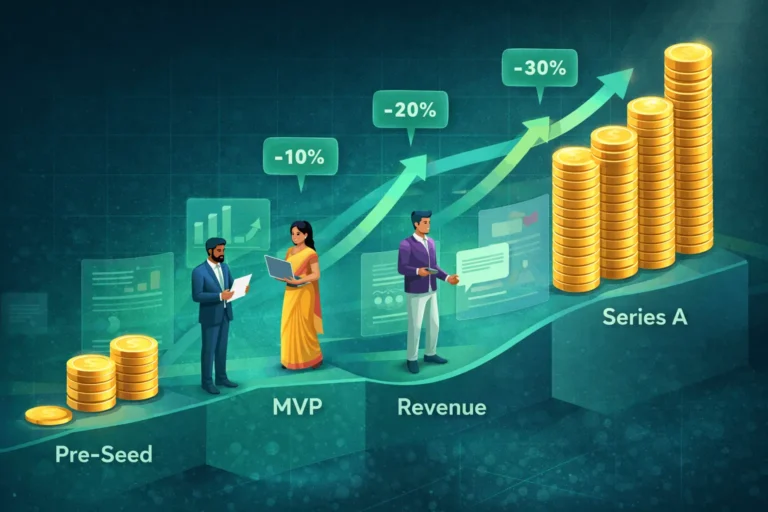
Seed funding and Series A funding serve different purposes in a startup’s growth journey. In 2026, investors are placing greater emphasis on product validation, revenue traction and sustainable business models, making it essential for founders to understand what each funding stage demands.
The Seed Funding vs Series A debate has become more important than ever as India’s startup ecosystem continues to mature. While venture capital activity has improved in 2026, investors remain selective and expect startups to demonstrate measurable progress before committing larger investments. Understanding the difference between these funding stages can help founders raise capital at the right time, avoid unnecessary dilution and build a stronger foundation for long-term growth.
Understanding Seed Funding in Today’s Startup Ecosystem
Seed funding is the first institutional investment that helps a startup transform an idea into a functioning business. At this stage, founders usually have a prototype, an early product or a minimum viable product (MVP), along with initial customer feedback.
The primary goal of seed funding is to validate the business model. Instead of focusing on rapid expansion, founders use the capital to build their product, hire key employees, improve technology and acquire early customers.
In India, seed investments often come from angel investors, startup accelerators, incubators, micro venture capital firms and dedicated seed funds. Government initiatives such as the Startup India Seed Fund Scheme have also helped eligible startups access early-stage capital.
By the end of the seed stage, investors generally expect startups to demonstrate product-market fit, customer engagement and a clear roadmap for future growth.
What Is Series A Funding and Why Does It Matter?
Series A funding comes after a startup has proven that its product solves a real market problem. At this stage, investors look beyond the idea and focus on execution, scalability and financial performance.
Unlike seed funding, Series A investments are designed to help companies expand their operations. The capital is typically used to strengthen sales and marketing, recruit experienced leadership, enter new markets and enhance product development.
Series A investors usually examine several performance indicators before investing. These include recurring revenue, customer acquisition costs, retention rates, unit economics, gross margins and market opportunity.
In 2026, venture capital firms are increasingly supporting startups that can demonstrate disciplined spending and sustainable growth instead of pursuing expansion at any cost. This reflects the broader shift toward capital efficiency across the global startup ecosystem.
Seed Funding vs Series A: The Key Differences
Although both funding stages aim to support startup growth, they differ significantly in terms of objectives, investor expectations and business maturity.
Seed funding focuses on proving that the business can work. Investors understand that uncertainty remains high and are willing to take greater risks in exchange for potential long-term returns.
Series A funding, however, is based on evidence rather than assumptions. Investors expect founders to present reliable financial data, customer traction and a scalable business model.
The due diligence process also becomes more detailed during Series A. Investors typically review financial statements, legal compliance, technology infrastructure, intellectual property, competitive positioning and long-term growth strategy before making investment decisions.
As a result, founders need stronger governance practices and more structured operations compared to the seed stage.
What Investors Expect From Founders in 2026
The funding environment has evolved considerably over the past few years. Investors are no longer prioritising growth alone. Instead, they seek businesses that combine innovation with financial discipline.
Founders preparing for seed funding should demonstrate a clear understanding of the market problem, customer needs and product differentiation. A capable founding team and realistic execution plan also play a major role in attracting early investors.
For Series A fundraising, expectations become significantly higher. Investors want evidence that customers are willing to pay for the product, revenue is growing consistently and the company has a repeatable sales process.
Artificial intelligence, fintech, enterprise software, climate technology, health technology and deeptech remain among the sectors attracting strong investor interest in 2026. However, startups in any industry can secure funding if they present compelling business fundamentals and measurable traction.
Common Mistakes Founders Should Avoid
Many startups struggle to raise funding because they approach investors before achieving the milestones expected at each stage.
One common mistake is raising Series A capital without first establishing product-market fit. Without strong customer validation, convincing institutional investors becomes much more difficult.
Another challenge is excessive dilution during seed funding. Founders who give away a large equity stake too early may face difficulties in future fundraising rounds.
Poor financial reporting, unrealistic revenue projections and weak governance practices can also reduce investor confidence. Maintaining transparent records, monitoring key performance metrics and communicating openly with investors are increasingly important as startups grow.
Preparation remains one of the strongest advantages founders can have during fundraising.
Looking Ahead
Choosing between seed funding and preparing for Series A is not simply about raising capital. It is about understanding where the business stands and what it needs to achieve next.
In 2026, successful fundraising depends less on market excitement and more on business execution. Investors continue to back innovative startups, but they expect founders to demonstrate customer demand, operational efficiency and sustainable growth.
For entrepreneurs, the lesson is straightforward. Raise seed funding to validate your business, and pursue Series A only after building a scalable company with proven market traction. Following this approach not only improves fundraising prospects but also strengthens the long-term future of the startup.
Key Takeaways
- Seed funding helps startups build products, validate ideas and achieve product-market fit.
- Series A funding focuses on scaling businesses with proven customer traction and revenue growth.
- Investors in 2026 prioritise profitability, capital efficiency and sustainable business models.
- Founders should align fundraising with business milestones rather than raising capital prematurely.
Frequently Asked Questions
Q1. What is the main difference between seed funding and Series A funding?
Seed funding supports product development and market validation, while Series A funding helps startups expand operations after demonstrating product-market fit and business traction.
Q2. Who typically invests in seed-stage startups?
Seed-stage startups are commonly funded by angel investors, startup accelerators, incubators, micro venture capital firms, dedicated seed funds and eligible government-backed funding programmes.
Q3. What metrics do Series A investors look for?
Series A investors typically evaluate revenue growth, customer acquisition, retention rates, unit economics, market opportunity, scalability and the overall strength of the management team.
Q4. Is it harder to raise Series A funding in 2026?
Yes. While investment activity has improved, venture capital firms are more selective and expect startups to demonstrate sustainable growth, strong financial discipline and measurable business performance before investing.
(Internal keyword suggestions: Seed Funding vs Series A, startup funding India, seed investment, Series A funding, venture capital India, startup fundraising 2026, startup funding stages, early-stage startups, startup investors, startup growth strategy)










Leave a comment