

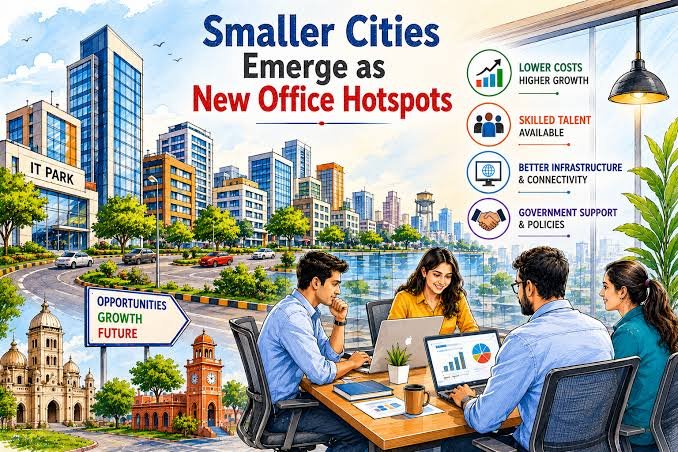
Smaller Indian cities are becoming increasingly important to India’s consumer economy as rising digital adoption, expanding e-commerce, stronger logistics and changing spending patterns bring more demand beyond major metros. For consumer businesses, Tier-2 and Tier-3 markets are moving from secondary markets to core growth opportunities.
India’s Consumer Growth Is Moving Beyond Metros
The rise of smaller cities is becoming a structural shift in India’s consumer market rather than a short-term trend. Recent industry data shows that Tier-2 and Tier-3 cities are generating a growing share of online purchases, while businesses are expanding distribution, fulfilment and customer acquisition strategies beyond traditional metropolitan centres.
The shift is particularly visible in the direct-to-consumer sector. According to Unicommerce data reported in April 2026, Tier-2 and Tier-3 cities accounted for nearly 66% of new D2C orders in FY26. Consumers in these markets also contributed about 60% of incremental gross merchandise value compared with FY25.
That matters because D2C brands typically rely on digital discovery and direct purchasing. Strong order growth outside metros suggests that consumers in smaller cities are increasingly comfortable discovering, evaluating and purchasing branded products online.
Tier-2 and Tier-3 Cities Are Driving D2C Demand
The D2C numbers provide one of the clearest indicators of how consumer demand is changing.
Unicommerce’s analysis, based on more than 400 million order items processed through its platform between April 2024 and February 2026, found that overall D2C order volumes increased 33% in FY26, while GMV rose 32%. Smaller cities were responsible for a significant portion of that expansion.
This creates a different growth equation for consumer companies. A brand no longer has to establish itself in Mumbai, Delhi, Bengaluru or other large metros before reaching a wider Indian customer base.
A consumer brand selling fashion, beauty products, food, personal care items or household products can increasingly reach customers in cities such as Nagpur, Jaipur, Indore, Surat, Lucknow, Coimbatore and other emerging markets through digital channels.
For businesses, this expands the addressable market without requiring the same physical retail footprint traditionally needed to enter a new geography.
Rising Aspirations Are Changing What Consumers Buy
The growth story is not limited to basic consumption.
Consumers in smaller cities are increasingly exposed to national and international brands through social media, e-commerce platforms, digital advertising and entertainment content. That exposure is influencing expectations around fashion, beauty, food, travel, electronics and lifestyle products.
Recent discussions among business leaders have also highlighted a more complex Indian consumer. Consumers increasingly want premium products and experiences, but remain conscious of value and quality. Importantly, this behaviour is not restricted to large metropolitan markets.
This creates opportunities for brands positioned between mass-market products and expensive luxury offerings.
A customer in a Tier-2 city may be willing to spend more on a skincare product, branded apparel, restaurant meal or electronic device if the product offers clear quality or differentiation. At the same time, price remains an important consideration.
The result is a consumer who is aspirational but selective.
Digital Payments and E-Commerce Have Reduced Geographic Barriers
One of the biggest changes supporting smaller-city consumption is the expansion of India’s digital infrastructure.
Consumers do not necessarily need a major shopping district nearby to access a national brand. Smartphones, digital payments, social commerce and e-commerce platforms have reduced the importance of physical proximity for many product categories.
The expansion of logistics networks has strengthened this shift. As delivery infrastructure improves, brands can serve customers across a much wider geographic area while using centralised inventory and regional fulfilment systems.
This is particularly important for D2C companies. A digitally native brand can test demand in a city without immediately investing in a large physical store network.
The same trend is visible in financial services. Upstox recently reported crossing two crore customers, with 85% of its user base coming from Tier-II and Tier-III cities. The figure illustrates how digital-first businesses can achieve significant adoption beyond India’s largest urban markets.
Consumer Businesses Are Expanding Their Regional Strategies
As smaller cities become more important, companies are having to rethink how they approach these markets.
A national strategy with identical pricing, advertising and product positioning may not always work. Consumer preferences can vary significantly between states and regions because of differences in language, culture, income levels and purchasing habits.
Regional-language marketing is therefore becoming increasingly important.
A brand targeting Maharashtra may need a different communication approach from one targeting Tamil Nadu or Uttar Pradesh. Product assortment can also vary according to local preferences.
For consumer companies, the opportunity is therefore not simply about selling existing products in more pin codes. It is about understanding local demand and building distribution around it.
This is particularly relevant for Tier-2 and Tier-3 markets, where local retailers, regional influencers and community-level recommendations can still play an important role alongside digital advertising.
Festive Demand Could Give Smaller Cities Another Push
The upcoming festive season is another factor that could strengthen consumer demand outside metros.
E-commerce, organised retail and quick-commerce companies are increasingly expanding operations in smaller cities as they prepare for higher seasonal demand. Recent reports indicate that festive hiring itself is shifting towards Tier-II and Tier-III cities as companies expand their operations in these markets.
For consumer brands, the festive period can be an important opportunity to acquire new customers.
Electronics, fashion, beauty, home products, food and gifting categories can all benefit from seasonal purchasing. But the competitive environment is also becoming more demanding.
Consumers have more choices than before, and brands must compete on pricing, availability, delivery speed, product quality and customer experience.
Why Smaller Cities Matter for Long-Term Growth
The bigger story is that India’s consumption base is becoming geographically more distributed.
KPMG has noted that growth is increasingly moving beyond major metropolitan centres, with Tier-2 and Tier-3 cities becoming important engines of infrastructure, manufacturing and digital expansion.
This can create a reinforcing cycle.
Better infrastructure can support businesses and employment. Greater economic activity can increase household incomes. Higher digital adoption can improve access to products and services. That, in turn, can encourage more consumer businesses to enter these markets.
For companies, this makes smaller cities less of an expansion experiment and more of a long-term strategic market.
The opportunity, however, should not be overstated. Consumer demand is not identical across every Tier-2 or Tier-3 city. Distribution costs, fragmented markets, local competition and varying purchasing power can still make expansion difficult.
Businesses that understand these differences are likely to have an advantage over companies that simply replicate their metro strategy.
What This Means for Consumer Businesses
The shift towards smaller cities changes how companies should think about growth.
Instead of viewing India’s largest cities as the primary market and smaller cities as an additional opportunity, businesses are increasingly treating emerging urban markets as part of their core customer base.
D2C brands are already seeing strong order growth from these locations. E-commerce is making national brands more accessible. Digital payments are simplifying transactions, while improving logistics are making wider distribution more practical.
The next stage will depend on whether companies can convert this growing demand into sustainable customer relationships.
Price-sensitive consumers may try a brand once because of a discount. Retaining them requires consistent quality, availability and service.
That is where the real test for consumer businesses will lie.
Key Takeaways
- Tier-2 and Tier-3 cities accounted for nearly 66% of new D2C orders in FY26.
- Smaller-city consumers are increasingly buying branded and aspirational products online.
- Digital payments, e-commerce and logistics are reducing geographic barriers for businesses.
- Localisation, pricing and product relevance will remain important as companies expand beyond metros.
FAQ
Why are Tier-2 and Tier-3 cities important for consumer businesses?
These markets have a growing base of digitally connected consumers, increasing brand awareness and expanding access to e-commerce. They are also contributing a significant share of new D2C orders.
Which consumer sectors are benefiting from smaller-city growth?
Fashion, beauty, personal care, electronics, food, household products and other D2C categories are among the sectors benefiting from increased digital consumption outside major metros.
Are consumers in smaller cities becoming more premium?
There is growing evidence of aspirational consumption beyond metros. However, consumers remain conscious of price and value, meaning brands need to balance premium positioning with affordability.
What challenges do companies face in Tier-2 and Tier-3 markets?
Companies need to manage regional preferences, language differences, logistics costs, fragmented demand, local competition and varying purchasing power. A strategy designed exclusively for metros may not work equally well in smaller markets.










Leave a comment