

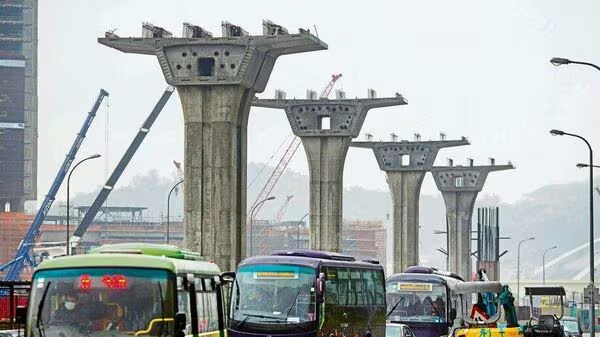
India’s rising government spending and a clear manufacturing rebound are shaping new growth pockets across smaller cities. This shift is strengthening local demand, improving job opportunities and pushing several sectors into a strong expansion cycle.
India’s economic momentum has been supported by higher public capital expenditure and a steady recovery in manufacturing output. Both trends are now translating into visible changes in Tier 2 and Tier 3 markets where new infrastructure and industrial activities are creating fresh demand cycles. Sectors that rely on regional growth, distributed supply chains and value driven consumption are poised to benefit the most.
Government Capital Expenditure And Local Growth Cycles
Government spending has been a major driver in India’s current growth phase, especially through higher allocations for roads, railways, logistics corridors and urban development. These projects generate employment at the local level, expand regional connectivity and create long term economic value. Smaller cities benefit disproportionately because new infrastructure directly reduces transport time, supports local businesses and attracts private investment.
Construction materials, cement, electrical equipment and project based services gain early when public spending accelerates. The multiplier effect takes hold as workers earn more, local shops see higher footfall and small service providers capture new demand. Over time, better roads and improved logistics allow manufacturers to expand or set up additional facilities in lower cost regions, deepening the economic base of non metro areas.
Manufacturing Rebound And The Rise Of Regional Industrial Clusters
Manufacturing activity has been improving as supply chains stabilise and domestic demand stays strong. Sectors such as auto components, consumer durables, electronics assembly, textiles and food processing are showing better utilisation levels. Many companies are diversifying production away from high cost metros and toward Tier 2 industrial zones where land, labour and utility costs are lower.
This shift supports job creation in smaller cities and builds a stronger local consumption layer. Workers employed in industrial units spend more on housing, transport, education, healthcare and daily retail needs. MSMEs supplying parts and services to these factories also scale with higher order volumes. As manufacturing spreads, it turns smaller cities into stable economic nodes rather than satellite markets dependent on metros.
Sectors Poised To Benefit From The Combined Movement
The combination of government spending and a manufacturing rebound creates opportunities across several sectors in Tier 2 and Tier 3 regions.
Retail and FMCG see immediate impact when disposable incomes rise in semi urban and industrial belts. Value driven consumer durables and two wheelers also benefit as credit availability improves and customers plan upgrades. Housing and building materials gain traction when workers migrate for jobs and rental demand increases.
Logistics and warehousing expand as new manufacturing units and consumption hubs require faster distribution networks. Financial services including small business loans, micro credit and affordable housing finance grow as regional entrepreneurs and households gain confidence. Education and skilling providers see higher enrolments because families prioritise employability in growing industrial towns.
How Local Businesses And MSMEs Gain From The Shift
MSMEs are at the center of this transition. Regional manufacturers, repair service providers, packaging units and local supply chain partners experience rising order books as large companies spread production. Government incentives for manufacturing, easier compliance systems and digital payment adoption further support small enterprises.
In many smaller cities, local entrepreneurs also find new opportunities in construction, equipment rentals, logistics services, food supply, cafeteria operations, security services and facility management. These ancillary businesses expand naturally around major infrastructure projects and industrial clusters. Improved connectivity reduces procurement costs and increases market reach, helping MSMEs scale beyond their immediate geography.
Challenges That Could Slow The Growth Momentum
Although the overall trend is positive, smaller cities still face structural challenges. Access to skilled labour, quality logistics infrastructure, reliable power supply and long term financing remains uneven. Some regions may see growth but lack institutional capacity to sustain or deepen industrial activity.
Urban planning gaps can also restrict scalable development. Without coordinated policies for land use, public transport, water management and industrial zoning, some cities may struggle to absorb rapid expansion. Private investment could slow if these gaps remain unresolved.
Takeaways
• Higher government spending and a manufacturing rebound are boosting growth in Tier 2 and Tier 3 cities
• Retail, FMCG, logistics, housing, consumer durables and MSMEs benefit early as incomes rise
• Industrial diversification into smaller cities strengthens job creation and local demand
• Structural gaps in infrastructure and planning may limit gains in some regions
FAQ
Q: What triggers faster growth in smaller cities when government spending rises
A: Local employment, construction activity and improved connectivity create new income flows that lift regional demand and attract private investment.
Q: Why is manufacturing shifting toward Tier 2 cities
A: Lower operating costs, better logistics corridors and government incentives encourage companies to diversify production away from metro areas.
Q: Which sectors grow first during a manufacturing rebound
A: Auto components, consumer durables, electronics, textiles and food processing typically see early gains due to strong domestic demand.
Q: What challenges could restrict growth in Tier 2 regions
A: Skill shortages, infrastructure gaps, inconsistent utilities and limited long term planning may slow industrial expansion.












Leave a comment