

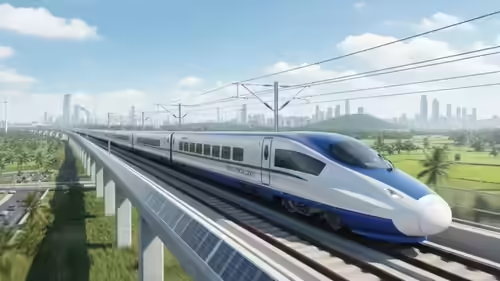
High speed rail corridors announced in Budget 2026 mark a major infrastructure shift with direct economic implications for Tier-2 cities. The projects aim to improve connectivity, reduce travel time and unlock new growth corridors beyond metro-centric development models.
Intent and nature of the topic
This is a time-sensitive news-led analysis. The tone is factual and explanatory, focused on immediate policy announcements and their economic implications for Tier-2 cities.
High speed rail corridors signal decentralised infrastructure planning
The high speed rail corridors announced in Budget 2026 reflect a strategic move toward decentralising economic growth. Instead of reinforcing only metro-to-metro connectivity, the new corridors link emerging industrial and commercial centres across states. This approach brings Tier-2 cities into national transport networks that were earlier dominated by large metros.
For cities such as Nagpur, Indore, Surat, Coimbatore and Vijayawada, high speed rail connectivity reduces the time cost of doing business. Faster passenger movement enables same-day intercity travel for executives, professionals and service providers. Over time, this shifts business location decisions away from saturated metros toward more affordable regional cities.
Secondary keywords like high speed rail infrastructure and regional connectivity upgrades define this shift in planning priorities.
Improved mobility drives business expansion and investment
Mobility plays a direct role in business scalability. With high speed rail corridors, Tier-2 cities gain faster access to capital markets, clients and supplier networks. This improves investor confidence and makes regional cities viable locations for corporate offices, back-end operations and industrial support units.
Service sectors such as IT services, consulting, healthcare and education benefit from improved intercity access. Manufacturing firms gain better coordination between plants, vendors and logistics hubs. Real estate developers also respond quickly to transport upgrades, leading to increased demand for commercial and mixed-use developments near stations.
The economic impact is not limited to transport efficiency but extends to land use patterns and investment flows.
Job creation and workforce mobility increase locally
High speed rail projects generate employment at multiple levels. Construction creates short- to medium-term jobs, while operations and maintenance generate long-term employment. More importantly, workforce mobility improves significantly for Tier-2 cities.
Professionals can live in lower-cost cities while accessing opportunities across regions. This reduces pressure on metro housing markets and supports balanced population growth. For Tier-2 cities, retaining skilled talent becomes easier when connectivity gaps are reduced.
Secondary keywords such as workforce mobility and regional employment growth highlight how transport infrastructure affects labour markets.
Manufacturing and logistics ecosystems gain momentum
While high speed rail primarily focuses on passenger movement, its indirect impact on manufacturing and logistics is substantial. Improved connectivity accelerates decision-making, site visits and coordination across supply chains. Tier-2 cities positioned near industrial corridors become more attractive for ancillary manufacturing units.
Cities with existing industrial bases benefit the most, as faster access to ports, airports and corporate centres improves operational efficiency. Over time, this encourages cluster development around high speed rail nodes, strengthening regional manufacturing ecosystems.
This complements freight-focused infrastructure such as dedicated corridors and logistics parks, creating a multi-layered transport network.
Urban development and real estate transformation
Urban economies respond quickly to transport infrastructure announcements. High speed rail corridors announced in Budget 2026 are expected to trigger planned urban development around station zones in Tier-2 cities. These zones often evolve into commercial districts, hospitality hubs and residential clusters.
Municipal bodies face both opportunities and challenges. Planned development can improve tax revenues and civic infrastructure if executed well. However, unregulated growth could strain utilities and urban services. Cities that align zoning policies with transport planning are likely to extract the most economic value.
Secondary keywords like transit-oriented development and Tier-2 city real estate growth become relevant in this context.
Impact on MSMEs and regional entrepreneurship
MSMEs and startups in Tier-2 cities stand to gain from improved market access. Faster travel enables entrepreneurs to reach customers, investors and partners without relocating to metros. This reduces operational costs and improves business sustainability.
Regional service providers, tourism operators and knowledge-based startups benefit from increased footfall and connectivity. High speed rail also improves access to government institutions, trade fairs and national business events, which are often concentrated in larger cities.
This strengthens local entrepreneurial ecosystems and encourages formalisation of small businesses.
Long-term economic rebalancing across regions
The broader economic impact of high speed rail corridors lies in regional rebalancing. India’s growth has historically concentrated around a few urban centres. By improving access and reducing distance barriers, Tier-2 cities can absorb more economic activity without compromising efficiency.
Over the long term, this reduces congestion costs, lowers regional inequality and improves resilience in the national economy. Budget 2026’s transport strategy indicates that infrastructure is being used as a tool for structural economic correction rather than only capacity expansion.
Takeaways
• High speed rail corridors integrate Tier-2 cities into national business networks
• Improved connectivity boosts investment, jobs and workforce mobility
• Urban development and real estate activity accelerate around rail nodes
• Long-term impact supports balanced regional economic growth
FAQs
Which cities benefit most from high speed rail corridors?
Tier-2 cities located along new corridors, especially those with existing industrial or service bases, benefit the most.
Does high speed rail directly help manufacturing businesses?
Yes. While primarily for passengers, it improves coordination, decision-making and investor access for manufacturers.
Will this reduce migration to metro cities?
Improved connectivity allows professionals to work across regions while living in Tier-2 cities, which can reduce long-term migration pressure.
How soon will economic benefits be visible?
Some effects like real estate activity and business interest appear early, while full economic impact unfolds over several years.












Leave a comment