

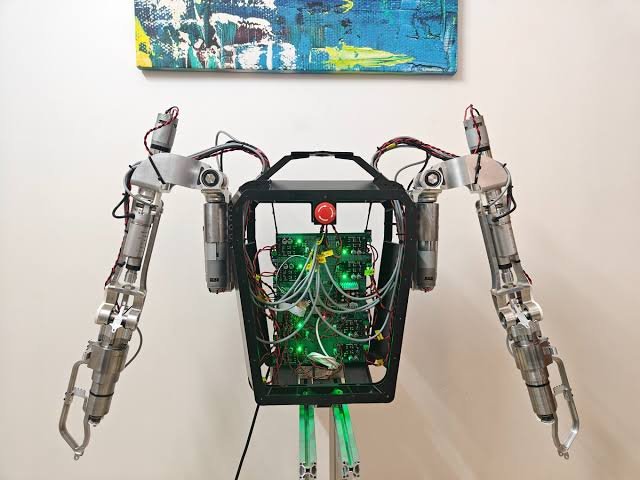
Avaana Capital’s ₹22.36 crore investment in Bengaluru-based Cosine Robots highlights growing venture capital interest in the hardware powering industrial automation. The funding reflects a wider shift towards robotics components, advanced manufacturing and technologies that can help Indian manufacturers reduce dependence on imported systems.
Avaana Capital’s Investment in Cosine Robots
Deeptech venture capital firm Avaana Capital has led a ₹22.36 crore funding round in Cosine Robots, with participation from WEH Ventures and angel investors. Announced on November 24, 2026, the investment will help the Bengaluru-based startup expand its research, engineering and manufacturing capabilities.
Founded by Kiran Mathew Koshy and Delip Thomas, Cosine Robots develops integrated servo actuators and motion systems for robotic applications. Its products combine precision motors, gearboxes, sensors, electronics and proprietary control software into a single system.
The company plans to use the capital to establish and scale a dedicated research and development and production facility. The facility will bring precision machining, assembly, calibration and endurance testing under one roof.
The investment is significant because Cosine is not primarily developing complete industrial robots. It is working on the components that allow robots to move accurately, handle loads and perform physical tasks. Company News – Business Standard+2
Why Venture Capital Is Looking Beyond Robotics Software
Robotics investment has traditionally attracted attention through visible products such as warehouse robots, automated production lines and humanoid machines. But the performance of these systems depends on several underlying technologies.
A robot needs motors, actuators, sensors, controllers, mechanical components and software to function. If one of these elements is unreliable or too expensive, the overall system can become difficult to deploy commercially.
This is creating investment opportunities in specialised hardware businesses. Startups developing robotic joints, motion-control systems, industrial sensors and precision components are addressing problems that affect the entire robotics ecosystem.
For venture capital firms, these businesses offer a different investment proposition from consumer technology startups. Their products may require longer engineering and testing cycles, but successful components can potentially be supplied to multiple robot manufacturers.
Cosine Robots fits this model. By developing actuator technology that can be adapted for different types of robots, the company is targeting a component market rather than relying on demand for a single finished machine. Company News – Business Standard+2
Robotic Actuators: The Hardware Behind Industrial Automation
Actuators are among the most important components in a robotic system. They convert energy into physical movement and control how robotic joints rotate, lift, grip or move.
In an industrial robotic arm, actuators help position tools and materials with precision. In collaborative robots, they support controlled movements when machines operate near human workers. In quadruped and humanoid robots, multiple actuators coordinate movement across different joints.
Cosine Robots is developing integrated servo actuators that combine several components into a single unit. Its portfolio includes modular cycloidal and planetary actuators designed for different torque requirements.
The company also says its proprietary control architecture uses dual-position sensing and a 25 kHz control loop, allowing 25,000 updates per second to regulate movement and torque.
This matters because actuator performance influences a robot’s precision, responsiveness, durability and operating cost. Improving these characteristics can make automation more practical for manufacturers that need machines to operate consistently over long production cycles. Company News – Business Standard+2
India’s Industrial Robotics Market Is Expanding
The investment comes as Indian factories increase their adoption of automation. According to the International Federation of Robotics (IFR), India installed approximately 10,500 industrial robots in 2025, a 15% increase from the previous year. India ranked sixth globally in annual industrial robot installations.
The global market also recorded a new high, with 603,307 industrial robots installed in 2025, up 11.2% year-on-year. Asia accounted for the largest share of installations, reflecting the region’s importance in global manufacturing.
In India, the automotive industry has been a major driver of robot adoption. Electronics, metal processing, machinery, chemicals and other manufacturing segments also offer opportunities for automation.
These figures help explain why investors are paying attention to industrial robotics. As more factories introduce automated systems, demand can grow not only for complete robots but also for the components, software and services required to operate them. International Federation of Robotics+2
Why Industrial Robotics Is Becoming a Venture Capital Opportunity
Venture capital investors are increasingly examining robotics businesses through the lens of technology ownership and industrial demand.
A company developing a specialised actuator, for example, may supply its technology to several robot manufacturers. This can create opportunities beyond selling a single finished machine. Similarly, businesses developing autonomous mobile robots, warehouse automation systems and factory software can serve multiple industrial customers.
Recent funding activity provides examples of this interest. Warehouse automation company Botsync announced an $11 million funding round led by IvyCap Ventures in November 2026. Other Indian robotics businesses, including ANSCER Robotics, have also attracted venture investment.
Financial Express reported in July 2026 that investors were becoming more receptive to robotics startups, with greater attention to engineering progress, patents and proprietary technology. The shift reflects an evolving approach to businesses that may need longer research and development periods before reaching scale.
For investors, the opportunity is linked to the possibility that industrial automation will become more widespread. However, robotics companies still need to demonstrate that their products solve measurable problems for customers and can be manufactured or deployed economically. The Financial Express+3
Why Avaana Capital Is Backing Robotics Hardware
Avaana Capital focuses on deeptech and innovation-led businesses, including advanced manufacturing, artificial intelligence, robotics, mobility and climate technology.
Its investment in Cosine Robots fits this focus on technologies with applications across industrial value chains. Rather than backing a company that only assembles robots using externally sourced components, Avaana is supporting a startup developing its own motion systems.
This distinction matters because the performance of industrial robots depends on the quality of their underlying components. A locally developed actuator platform could give Indian robot manufacturers another sourcing option, while allowing them to work more closely with the engineering team responsible for the component.
Avaana partner Vikas Verma has described Cosine’s work as an effort to combine precision mechanics, proprietary controls and manufacturing expertise. WEH Ventures managing partner Deepak Gupta has also highlighted the importance of capable actuator suppliers for the wider robotics ecosystem.
The investment is therefore a bet on a foundational layer of robotics technology, although commercial adoption and manufacturing scale will determine its eventual value. Company News – Business Standard+2
Can Domestic Actuator Manufacturing Reduce Import Dependence?
India’s robotics industry still faces challenges in building a complete domestic component supply chain. High-precision motors, sensors, controllers, gear systems and specialised manufacturing equipment require advanced engineering capabilities.
When robot manufacturers depend heavily on imported components, they may face longer procurement cycles, currency-related cost fluctuations and limited flexibility in customising products. These factors can affect production costs and the speed at which new robotic systems are developed.
Domestic actuator manufacturers could help address part of this gap. If companies such as Cosine Robots can produce reliable components at competitive prices, Indian robotics businesses may gain more flexibility in designing machines for local industrial requirements.
Local manufacturing could also create opportunities for specialised suppliers, engineering talent and precision manufacturing companies.
However, localisation does not automatically guarantee lower costs or better performance. Indian suppliers must meet demanding standards for durability, accuracy, safety and consistency. They also need to achieve production volumes that make their products commercially competitive with established international suppliers.
For Cosine, the planned production facility is an important step towards building these capabilities. Its ability to deliver consistent products to robot manufacturers will be a key factor in determining its position in the market.
Cosine Robots’ Next Challenge Is Commercialisation
The funding gives Cosine Robots resources to expand its engineering and manufacturing operations, but the company must now translate its technology into products that customers are willing to purchase at scale.
Its upcoming facility will integrate precision machining, assembly, calibration and endurance testing. These capabilities are important because robotic actuators must operate reliably under repeated movement, varying loads and demanding industrial conditions.
The company is developing cycloidal and planetary actuator designs for different torque requirements. This modular approach could allow it to serve multiple categories of robotics customers, including manufacturers of industrial arms, collaborative robots, quadrupeds and humanoid machines.
The Economic Times has reported that the company’s actuator portfolio is expected to move towards commercialisation around February 2027.
The commercialisation phase will require customer trials, performance validation, pricing decisions and reliable delivery. Robot manufacturers will also evaluate how easily Cosine’s components integrate with their existing mechanical and control systems.
The startup’s ability to secure repeat orders will matter more than the announcement of its production infrastructure alone. The Economic Times+2
Risks Venture Capital Investors Will Need to Watch
Industrial robotics offers a large technology opportunity, but it also involves risks that can affect startup growth and investor returns.
- Long development cycles: Hardware products require engineering, prototyping, testing and validation before commercial deployment.
- Manufacturing costs: Precision components need specialised equipment, skilled workers and strict quality control.
- Customer adoption: Industrial buyers often take time to evaluate new suppliers because equipment failures can disrupt production.
- Established competition: Global actuator and robotics component manufacturers already have technical experience, production capacity and customer relationships.
- Scaling challenges: A product that performs well in small batches may require further engineering and process improvements before mass production.
These factors explain why venture capital investment in robotics can involve longer timelines than investments in many software businesses. Investors must evaluate technical progress alongside customer demand, manufacturing readiness and the company’s ability to build a sustainable business.
What Avaana’s Investment Signals for India’s Robotics Ecosystem
Avaana Capital’s backing of Cosine Robots reflects growing interest in the industrial infrastructure behind automation. Investors are looking beyond finished robots to the specialised components that determine how efficiently machines perform physical tasks.
India’s rising industrial robot installations provide a relevant market signal. At the same time, the domestic ecosystem needs stronger capabilities in precision engineering, sensors, actuators, controllers and other critical hardware.
The latest investment is one example of venture capital moving towards these specialised technologies. Funding activity involving Botsync and other robotics companies also shows that investors are examining opportunities across factory automation, warehouse operations and robotics hardware.
For Cosine Robots, the immediate priorities are to establish manufacturing capabilities, complete product development and build relationships with robot manufacturers.
If it can achieve these milestones, the company could become part of a broader domestic supply chain supporting India’s industrial automation market. But its long-term position will depend on product reliability, competitive pricing and commercial adoption.
The larger opportunity is not simply to manufacture more robots in India. It is to develop the technology and component suppliers that make those robots commercially viable.
Key Takeaways
- Avaana Capital has led a ₹22.36 crore funding round in Cosine Robots, with participation from WEH Ventures and angel investors.
- Cosine develops integrated servo actuators and motion systems for industrial robotic arms, collaborative robots, quadrupeds and humanoids.
- India installed approximately 10,500 industrial robots in 2025, up 15% year-on-year, according to the International Federation of Robotics.
- Venture capital interest in robotics hardware is increasing, but manufacturing quality, commercial adoption and competition will determine long-term growth.
Frequently Asked Questions
1. Why has Avaana Capital invested in Cosine Robots?
Avaana Capital is backing Cosine’s development of integrated servo actuators and motion systems. These components are important for improving the precision, reliability and cost of industrial and advanced robotics.
2. What does Cosine Robots manufacture?
Cosine Robots develops integrated servo actuators combining motors, gearboxes, sensors, electronics and proprietary control software. Its products are designed for different types of robotic systems.
3. Why are industrial robotics startups attracting venture capital?
Growing factory automation, demand for precision manufacturing and the development of domestic robotics technology are creating investment opportunities. Investors are also exploring specialised hardware businesses that can supply multiple robotics manufacturers.
4. Can Indian companies reduce dependence on imported robotics components?
Domestic companies developing actuators, sensors, motors and control systems could provide additional sourcing options. However, they must demonstrate competitive pricing, reliable performance and the ability to manufacture consistently at scale.











Leave a comment