

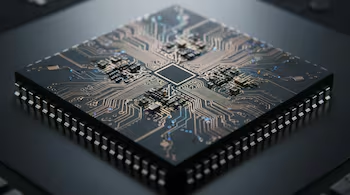
Agrani Labs is in advanced discussions to raise around $50 million as investors increase their focus on India’s semiconductor startups. The proposed round comes as funding shifts toward deeper technology, AI chips and companies moving closer to commercialisation.
Agrani Labs seeks $50 million in fresh funding
Agrani Labs, a Bengaluru-based semiconductor startup, is in advanced discussions to raise around $50 million in a new funding round, according to a September 1 report by Moneycontrol. Existing investor Peak XV Partners is expected to participate with around $15 million, while 360 One is among the potential new investors, according to people cited in the report.
The proposed transaction reportedly values Agrani Labs at around $160 million to $200 million. That would represent a substantial increase from the approximately $35 million valuation reported when Peak XV invested $8 million in the company’s seed round in June 2025.
The round has not been publicly announced as closed, so the reported funding should be treated as a proposed transaction rather than completed financing.
That distinction is important in semiconductor funding, where large rounds often depend on technical milestones, investor due diligence and the company’s product-development roadmap.
Why Agrani Labs matters to India’s semiconductor push
Agrani Labs was founded in 2024 by Dheemanth Nagaraj, Ashok Jagannathan, Srikanth Nimmagadda and Rajesh Vivekanandham, executives with experience at Intel and AMD. Peak XV identifies the company as a DeepTech and AI venture focused on building AI GPUs and end-to-end software for enterprise and data-centre computing.
The company is attempting to build more than a chip. Its stated approach includes hardware as well as software such as compilers, libraries, system software and AI frameworks.
This full-stack strategy is significant because AI accelerators compete not only on raw chip performance. Developers also need software tools and frameworks that allow applications to run efficiently on the underlying hardware.
Agrani Labs emerged from stealth in early 2026 after raising an $8 million seed round led by Peak XV Partners. At the time, the startup said the capital would be used to expand engineering and accelerate product development.
Indian semiconductor funding is entering a new phase
Agrani Labs’ reported funding discussions come against a broader change in India’s semiconductor startup market.
A report by Speciale Invest and the Startup Policy Forum found that Indian semiconductor startups raised approximately $206 million across 51 funding rounds between 2022 and the first half of 2026. Startups raised $61.9 million in the first six months of 2026 alone, equivalent to about 81% of the $76.6 million raised during the whole of 2025.
At the same time, the number of deals has fallen. Funding rounds declined from 16 in 2024 to 13 in 2025 and seven in the first half of 2026.
The combination of fewer deals and more capital suggests that investors are becoming more selective. Instead of spreading relatively small amounts across many early-stage companies, investors are increasingly backing startups that have moved further along the product-development and commercialisation cycle.
That environment could favour companies such as Agrani Labs if they can demonstrate meaningful progress in chip architecture, software and product validation.
AI chips are becoming a strategic funding category
The demand for AI computing has changed the semiconductor investment landscape globally.
Training and running advanced AI models requires large amounts of computing power. Data centres therefore need specialised processors and supporting infrastructure that can deliver high performance while managing power consumption and operating costs.
Nvidia remains the dominant global supplier of AI accelerators, while companies such as AMD and other semiconductor firms are developing competing solutions. For Indian startups, entering this market means competing against companies with enormous engineering budgets and established software ecosystems.
Agrani Labs is attempting to address this challenge by developing its own AI GPU and accompanying software stack. Its founders’ previous experience at major semiconductor companies is another factor that investors may consider when assessing the company’s ability to execute.
However, securing funding is only one stage of the process. Building a competitive semiconductor product requires years of engineering, validation, manufacturing coordination and customer adoption.
Government support is helping private capital enter semiconductors
India’s semiconductor strategy has also created a stronger policy environment for domestic chip companies.
The government’s Design Linked Incentive programme has supported Indian chip-design startups, helping companies move from early concepts toward product development. According to the Speciale Invest and Startup Policy Forum report, 14 of 24 chip-design startups supported under the DLI programme subsequently raised institutional venture capital, collectively securing $100.8 million across their first and second funding rounds.
The data suggests that public support can play a role in reducing some of the early financial barriers associated with semiconductor development.
This matters because semiconductor startups typically require more capital and longer development cycles than many software businesses. A company may need significant funding before it generates meaningful revenue.
Government incentives can therefore help startups reach technical milestones that make them more attractive to private investors.
Semicon 2.0 broadens India’s semiconductor ambitions
The funding discussions also arrive shortly after the government’s latest semiconductor policy push.
The newly notified Semicon 2.0 programme has an outlay of about ₹1.27 lakh crore, according to the September 1 Moneycontrol report. The programme is intended to support a broader semiconductor ecosystem covering areas including chip design, fabrication, advanced packaging, equipment, materials and research and development.
The wider policy direction matters for startups because India’s semiconductor ambitions are no longer limited to attracting large manufacturing facilities.
A functioning semiconductor ecosystem requires companies across the value chain. That includes fabless chip designers, intellectual-property developers, semiconductor equipment suppliers, packaging companies, testing businesses and specialised technology providers.
For startups, this creates potential opportunities beyond traditional chip design.
The semiconductor race is expanding beyond chip design
India’s startup semiconductor ecosystem is becoming more diverse.
Recent funding data shows growing activity in areas including AI-focused silicon, photonics, power semiconductors, packaging and other specialised technologies. The shift is important because semiconductor manufacturing cannot depend on a single category of company.
A country may have strong chip designers but still remain dependent on overseas suppliers for manufacturing equipment, advanced packaging, specialised materials or fabrication.
For Indian startups, this creates multiple possible entry points. Some companies can focus on designing processors, while others can build components and technologies that support data centres, electric vehicles, industrial systems or communications infrastructure.
Agrani Labs is positioned in one of the most strategically important areas, AI computing, but it is only one part of a much larger ecosystem now developing in India.
Bigger funding also brings bigger expectations
A potential $50 million round would give Agrani Labs substantially more capital to expand engineering, research and product development. But larger funding rounds also raise expectations from investors.
The company would need to convert capital into measurable technical progress, product milestones and eventually commercial opportunities.
That is particularly important in the semiconductor sector, where the gap between a promising architecture and a commercially successful chip can be significant.
The startup’s earlier $8 million seed round provided capital to build the initial platform. A much larger round would potentially support the next phase of development, but the precise use of funds will depend on the final financing terms.
For investors, the key questions will be whether Agrani can develop competitive performance, create a usable software ecosystem and find customers willing to deploy its technology.
What Agrani Labs means for India’s chip startup race
Agrani Labs’ reported funding talks highlight a broader change in India’s startup ecosystem. Semiconductor companies are increasingly being viewed as long-term technology businesses rather than experimental research projects.
The recent funding data supports that trend. Capital is rising even as the number of deals falls, suggesting that investors are becoming more comfortable making larger bets on companies that demonstrate technical progress.
For India, that shift could be important. Semiconductor development requires patient capital, specialised engineering talent and access to global technology and manufacturing ecosystems.
The country already has a large pool of semiconductor design professionals, while government programmes are attempting to build more domestic capabilities across the supply chain.
Agrani Labs’ proposed funding round is therefore worth watching not simply because of its reported $50 million size. It is another indication that investors are beginning to place larger bets on Indian deeptech companies operating in strategically important areas.
The real test, however, will come after the funding. Turning capital into competitive silicon, reliable software and paying customers will determine whether India’s semiconductor startups can move from promising designs to globally relevant businesses.
Key Takeaways
- Agrani Labs is reportedly in advanced discussions to raise around $50 million, with Peak XV Partners and 360 One among the investors involved in the talks.
- The Bengaluru startup is developing AI GPUs alongside software including compilers, libraries, system software and AI frameworks.
- Indian semiconductor startups raised $61.9 million in the first half of 2026, taking cumulative funding since 2022 to about $206 million across 51 rounds.
- Investors are increasingly concentrating capital in semiconductor startups that have progressed toward product development and commercialisation.
Frequently Asked Questions
What is Agrani Labs developing?
Agrani Labs is developing AI GPUs and a full-stack software platform for enterprise and data-centre computing. Its software work includes compilers, libraries, system software and AI frameworks designed to work alongside its hardware.
How much funding is Agrani Labs reportedly seeking?
Agrani Labs is reportedly in advanced discussions to raise around $50 million. Moneycontrol reported that Peak XV could contribute approximately $15 million, with the remaining capital potentially coming from new investors including 360 One. The round has not been publicly confirmed as closed.
How much have Indian semiconductor startups raised?
Indian semiconductor startups have raised approximately $206 million across 51 funding rounds since 2022. Funding reached $61.9 million in the first half of 2026, compared with $76.6 million across the whole of 2025.
Why is semiconductor funding important for India?
Semiconductor development requires substantial capital and long development timelines. Funding can help Indian companies develop chip designs, software, testing capabilities and other technologies while government programmes can reduce some early-stage financial barriers. The broader goal is to build capabilities across India’s semiconductor value chain.
(Internal keywords: Agrani Labs funding, Agrani Labs $50 million, Agrani Labs Peak XV, Indian semiconductor startups, semiconductor funding India 2026, AI chip startups India, India semiconductor ecosystem, Indian chip startups, semiconductor venture capital, AI GPU startup India, Semicon 2.0, semiconductor startup funding)












Leave a comment