

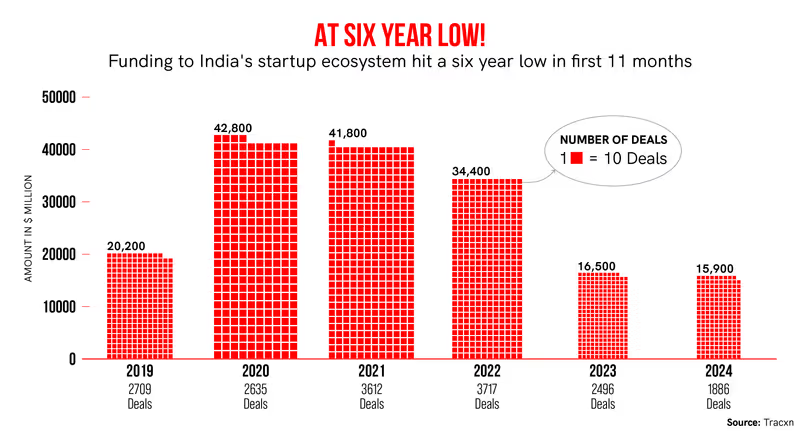
Early stage vs late stage funding in India has undergone a structural reset during 2025 and 2026. Capital is no longer chasing speed alone. Investors are recalibrating deployment strategies to balance risk, returns, and timelines in a more disciplined venture environment.
Early stage vs late stage funding in India now reflects a clear change in investor behaviour shaped by macro conditions. Rising interest rates, longer exit cycles, and uneven public market performance have forced venture capital firms to rethink how and where capital is deployed. The result is a more deliberate split between early experimentation and late stage consolidation.
Macro Conditions Driving the Funding Reset
The 2025 to 26 period has been defined by tighter global liquidity and cautious risk appetite. Capital is available, but it is selective. India has not been immune to this shift. Venture firms are prioritising portfolio durability over rapid expansion.
Late stage funding has slowed as investors reassess valuation benchmarks set during the previous cycle. With IPO timelines extending and secondary exits becoming harder, late stage cheques now require clearer profitability visibility. At the same time, early stage funding remains active because entry valuations are lower and upside potential is still intact.
This macro backdrop has pushed investors to rebalance portfolios rather than retreat from the market entirely.
Early Stage Funding Finds New Importance
Early stage funding in India has emerged as a relative bright spot. Seed and Series A rounds continue to close, particularly for startups addressing clear market gaps. Investors are comfortable taking early risks when capital requirements are modest and founder quality is strong.
The focus at this stage has shifted to fundamentals. Business models are expected to show early signs of revenue, realistic customer acquisition costs, and a credible path to scale. Growth at any cost is no longer acceptable, even at the earliest stages.
This recalibration benefits disciplined founders. Startups with focused offerings and capital efficiency are raising funds faster than those built on broad expansion narratives.
Late Stage Funding Becomes Highly Selective
Late stage funding in India has become more selective and structured. Investors are reserving large cheques for companies that demonstrate operating leverage, stable margins, and predictable cash flows. Capital is often deployed in tranches linked to performance milestones.
Valuation sensitivity is high. Many late stage startups are being asked to grow into their previous valuations rather than raise at higher prices. This has led to fewer but more thoughtful deals. Some companies are choosing to delay fundraising or explore alternative financing options.
The emphasis is on survival and sustainability rather than market dominance.
Sector Preferences Shape Capital Allocation
Sector selection plays a major role in how early stage vs late stage funding is distributed. Enterprise software, climate technology, healthcare services, and manufacturing focused startups attract early stage interest due to long term demand visibility.
At the late stage, financial services, infrastructure aligned platforms, and profitable consumer brands see more traction. These sectors offer clearer paths to cash generation and eventual exits. In contrast, sectors dependent on discretionary spending or regulatory uncertainty face tighter scrutiny.
This sector wise differentiation reflects a maturing venture ecosystem that understands cyclical risk better than before.
Changing Role of Founders and Operators
Founders are adapting to the recalibrated funding environment. Early stage entrepreneurs are building leaner teams and prioritising revenue sooner. Late stage founders are focusing on governance, cost controls, and realistic growth guidance.
Operational excellence has become a funding differentiator. Investors increasingly evaluate leadership depth, execution track record, and capital allocation decisions. This shift rewards experienced operators and penalises aggressive but unfocused expansion.
The result is healthier company building, even if growth appears slower on the surface.
Impact on Valuations and Deal Structures
Valuations across stages have normalised. Early stage valuations remain grounded, allowing investors to take ownership positions without excessive risk. Late stage valuations are being reset through flat rounds, structured instruments, or delayed raises.
Deal structures now include performance linked payouts, downside protection, and longer investment horizons. These mechanisms align investor and founder incentives while acknowledging market uncertainty.
This evolution indicates that capital deployment strategies are becoming more sophisticated rather than conservative.
What This Recalibration Means for the Ecosystem
The recalibration of early stage vs late stage funding in India signals a transition from exuberance to endurance. Capital is still flowing, but with intent. This phase favours companies that can survive cycles, not just ride momentum.
Over the long term, this environment strengthens the startup ecosystem. It filters out weak models early, supports genuine innovation, and prepares late stage companies for public market scrutiny. India’s venture ecosystem is not shrinking. It is maturing.
Outlook for 2026 and Beyond
Looking ahead, early stage funding is expected to remain resilient, driven by new founder pipelines and domestic market opportunities. Late stage funding will depend on exit visibility and earnings quality.
As public markets stabilise and exits reopen, late stage capital may return with confidence. Until then, disciplined capital deployment will define the venture landscape. Investors and founders who align with this reality are best positioned to succeed.
Takeaways
- Early stage funding remains active due to lower risk entry points and innovation demand
- Late stage funding is selective and tied to profitability and cash flow visibility
- Sector preferences now strongly influence capital allocation decisions
- The funding reset is creating a more disciplined and durable startup ecosystem
FAQs
Why is early stage funding stronger than late stage funding right now?
Lower valuations and flexible timelines make early stage investments less risky in uncertain markets.
Are late stage startups struggling to raise capital?
Only those without clear profitability or exit visibility face challenges.
Has venture capital exited India during 2025 and 26?
No. Capital is still active but deployed more selectively and strategically.
What should founders prioritise in this funding environment?
Capital efficiency, realistic growth plans, and strong execution fundamentals.












Leave a comment