

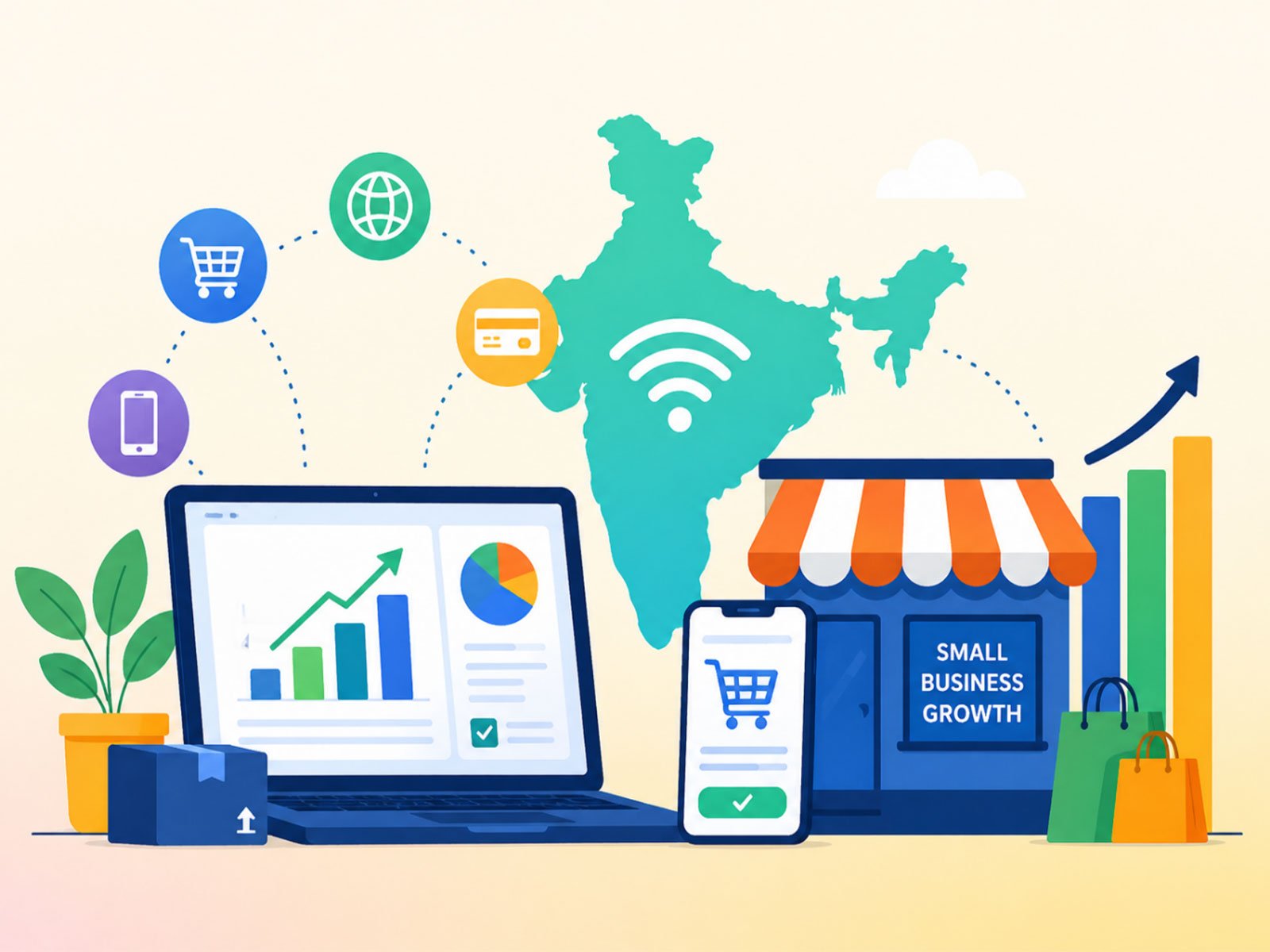
India’s digital economy is creating new opportunities for small businesses through digital payments, e-commerce, cloud technology, online marketing, and government-backed digital infrastructure. Businesses that embrace these tools can improve efficiency, reach more customers, and compete with larger companies at lower costs.
India’s Expanding Digital Economy Opens New Doors for Small Businesses
India’s expanding digital economy is transforming the way small businesses operate. Affordable internet access, widespread smartphone usage, digital payment systems, and government-backed digital public infrastructure have made it easier than ever for entrepreneurs to start, manage, and grow their businesses.
The digital economy is no longer limited to large corporations or metro cities. Kirana stores, home-based businesses, local manufacturers, retailers, service providers, and startups in Tier 2 and Tier 3 cities are increasingly adopting digital tools to serve customers more efficiently.
Digital platforms have reduced many traditional barriers such as high marketing costs, limited customer reach, and dependence on physical stores. Today, even a small business can attract customers from across India with the right online presence.
Digital Payments Are Improving Business Efficiency
One of the biggest drivers of India’s digital economy has been the rapid adoption of digital payments. Unified Payments Interface (UPI), QR code payments, internet banking, and digital wallets have simplified transactions for businesses of every size.
For small businesses, digital payments offer several advantages:
- Faster payment collection
- Reduced dependence on cash
- Better transaction records
- Improved financial transparency
- Easier access to business loans through digital financial history
A digital transaction history can also help businesses demonstrate revenue consistency when applying for working capital or credit from banks and financial institutions.
E-commerce Platforms Help Businesses Reach More Customers
E-commerce growth for MSMEs
Online marketplaces have created significant opportunities for India’s Micro, Small and Medium Enterprises (MSMEs). Businesses that once depended solely on local customers can now sell products across multiple states.
Whether selling clothing, handicrafts, electronics, food products, or home décor, digital marketplaces allow entrepreneurs to reach larger audiences without investing heavily in physical expansion.
Many businesses also use their own websites and social media channels to receive direct orders, reducing reliance on traditional retail networks.
For businesses located in smaller cities, this has created access to national markets that were previously difficult to reach.
Digital Marketing Makes Growth More Affordable
Online marketing for small businesses
Traditional advertising often requires substantial budgets. Digital marketing has made promotion more accessible for businesses with limited resources.
Small businesses can use platforms such as search engines, social media, messaging applications, and email marketing to engage customers at relatively low costs.
Some effective digital marketing strategies include:
- Creating informative social media content
- Running location-based online advertisements
- Listing businesses on online maps and directories
- Collecting customer reviews
- Sharing product videos and demonstrations
Positive customer reviews and consistent online engagement also help build trust among potential buyers.
Cloud Technology and Digital Tools Increase Productivity
Modern business software has become affordable even for small enterprises.
Cloud-based accounting, inventory management, payroll systems, invoicing software, and customer relationship management (CRM) tools help automate routine tasks.
These technologies reduce paperwork, improve accuracy, and save valuable time.
Business owners can monitor sales, manage inventory, generate invoices, and analyse performance using smartphones or laptops without maintaining expensive IT infrastructure.
Digital bookkeeping also simplifies tax compliance and financial reporting.
Government Digital Infrastructure Supports Business Growth
Government initiatives for digital business
India’s digital public infrastructure has contributed significantly to small business growth.
Initiatives such as Aadhaar-enabled services, UPI, GST digitisation, the Open Network for Digital Commerce (ONDC), and various MSME support programmes have encouraged greater digital participation.
Businesses can also access online registration, tax filing, licensing, and compliance services through government portals, reducing paperwork and administrative delays.
Several government schemes additionally provide digital training, financial assistance, and support for technology adoption among MSMEs.
Challenges Small Businesses Should Prepare For
While the opportunities are significant, digital transformation also requires careful planning.
Businesses should pay attention to cybersecurity, customer data protection, online fraud prevention, and employee digital skills.
Choosing reliable software providers, using strong passwords, enabling multi-factor authentication, and regularly updating systems are basic but essential cybersecurity practices.
Business owners should also invest in digital literacy so employees can confidently use new technologies and online platforms.
The businesses that combine digital adoption with customer trust and operational efficiency are likely to remain competitive over the long term.
The Future of Small Businesses in India’s Digital Economy
India’s digital economy continues to create a level playing field for businesses of all sizes. Technology has reduced entry barriers, improved access to customers, simplified financial transactions, and enabled entrepreneurs to operate more efficiently.
For small businesses, success no longer depends solely on physical location or large investments. Those that embrace digital payments, online marketing, e-commerce, cloud technology, and digital financial tools are better positioned to expand their customer base and improve profitability.
As digital infrastructure continues to strengthen across the country, particularly in Tier 2 and Tier 3 cities, small businesses have an opportunity to become important contributors to India’s economic growth.
Key Takeaways
- Digital payments improve cash flow, transparency, and financial management.
- E-commerce enables small businesses to sell beyond their local markets.
- Affordable digital marketing helps businesses reach customers with lower advertising costs.
- Government digital infrastructure and cloud-based tools are making business operations more efficient.
FAQs
Q1. What is India’s digital economy?
India’s digital economy includes economic activities powered by digital technologies such as online payments, e-commerce, cloud computing, digital services, internet platforms, and digital public infrastructure.
Q2. How can small businesses benefit from digital payments?
Digital payments enable faster transactions, reduce cash handling, improve record keeping, and help businesses build financial histories that may support future loan applications.
Q3. Why is digital marketing important for small businesses?
Digital marketing allows businesses to reach targeted audiences, increase brand visibility, engage customers, and promote products at a relatively lower cost than many traditional advertising methods.
Q4. What are the biggest challenges of digital adoption?
Common challenges include cybersecurity risks, employee training, digital literacy, protecting customer data, and selecting the right technology solutions.











Leave a comment