

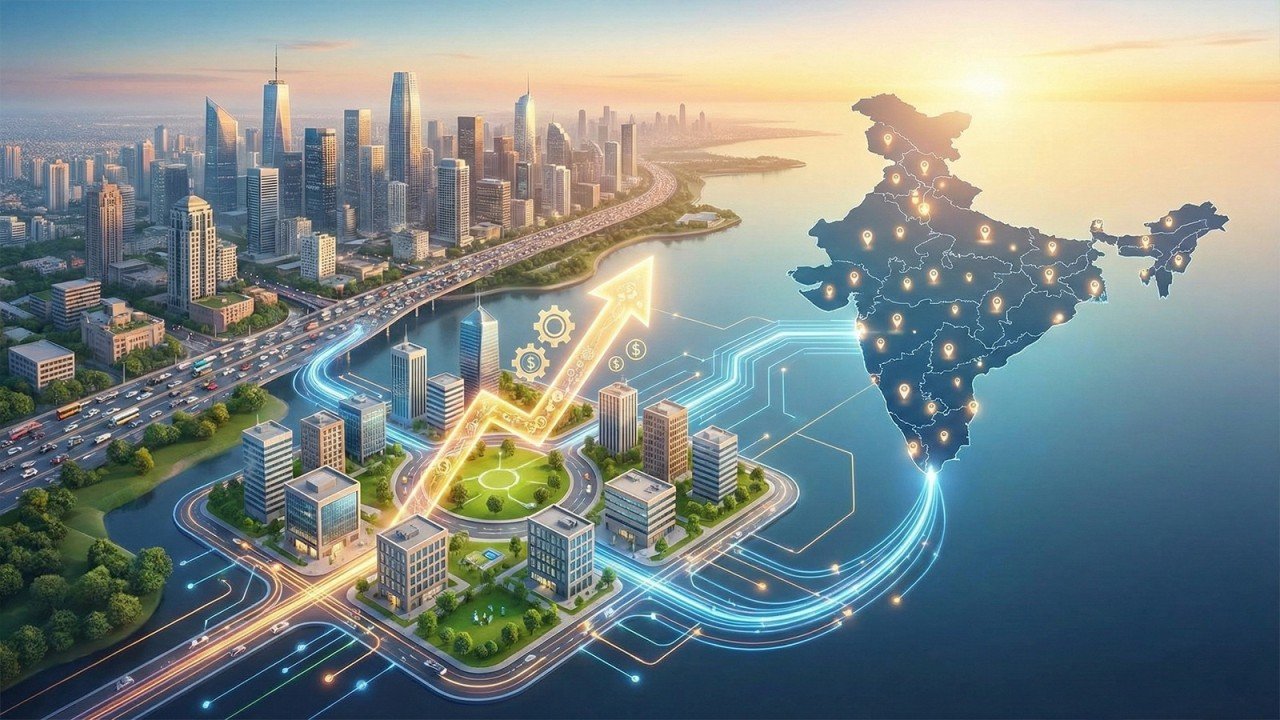
India’s Tier-2 cities are emerging as the country’s next business growth hubs as companies expand beyond traditional metro markets. Rising infrastructure investments, lower operating costs, improved digital connectivity, and a growing skilled workforce are encouraging businesses to establish manufacturing units, technology centres, logistics facilities, and Global Capability Centres (GCCs) in smaller cities. This shift is expected to create new employment opportunities while driving balanced regional development across India.
India’s economic growth has historically been concentrated in metropolitan cities such as Bengaluru, Mumbai, Delhi, Hyderabad, Chennai, and Pune. However, rising commercial real estate costs, increasing competition for talent, and infrastructure pressure in these cities are encouraging businesses to explore alternative locations. Government policies and private investments are accelerating this transition, making Tier-2 cities an important part of India’s long-term business strategy.
Businesses Are Looking Beyond Metro Cities
The biggest reason behind this shift is economics. Companies can significantly reduce operating costs by setting up offices, manufacturing facilities, or technology centres in emerging cities while maintaining access to skilled professionals.
Recent discussions at the CII GCC Summit highlighted that India’s next wave of Global Capability Centres will increasingly move beyond traditional technology hubs. Officials from the Ministry of Electronics and Information Technology said the GCC ecosystem is entering a new growth phase where Tier-2 cities are expected to play a much larger role. States including Uttar Pradesh, Maharashtra, Kerala, and Bihar have introduced policies and infrastructure initiatives to attract multinational companies.
This expansion is no longer limited to information technology. Companies in engineering, finance, healthcare, electronics, logistics, research, and business services are also evaluating emerging cities as long-term investment destinations.
Infrastructure Development Is Supporting Business Expansion
One of the major reasons businesses are considering smaller cities is the improvement in infrastructure over the past decade.
Industrial corridors, expressways, modern airports, dedicated freight corridors, better internet connectivity, and improved logistics networks have made many Tier-2 cities more attractive for investment. Government initiatives such as PM Gati Shakti, Bharatmala, industrial parks, and digital infrastructure projects have reduced some of the traditional disadvantages associated with smaller cities.
Improved connectivity allows companies to manage operations efficiently while remaining connected with customers, suppliers, and global markets. Better infrastructure has also encouraged real estate developers to build commercial office spaces, technology parks, and industrial clusters outside metropolitan areas.
GCCs Are Creating New Employment Opportunities
Global Capability Centres have become one of the strongest drivers of business expansion beyond metro cities.
Finance Minister Nirmala Sitharaman recently stated that while the first wave of GCC growth was concentrated in metropolitan cities, the next phase will spread across Tier-2 and Tier-3 locations, supporting balanced regional development. Industry leaders believe these cities offer lower employee attrition, competitive operating costs, and access to engineering graduates from regional universities.
Cities such as Indore, Coimbatore, Bhubaneswar, Visakhapatnam, Chandigarh, Kochi, Jaipur, Nagpur, Lucknow, and Vadodara are increasingly being viewed as potential destinations for technology, analytics, engineering, cybersecurity, finance, and back-office operations.
As more multinational companies adopt a multi-city strategy, employment opportunities are expected to expand across these emerging locations.
Startups and MSMEs Are Fueling Regional Growth
Business growth in Tier-2 cities is not being driven only by large corporations.
Local startups and MSMEs are playing an equally important role by creating innovation ecosystems around manufacturing, logistics, fintech, agritech, healthcare, education technology, and software services.
Lower office rentals and relatively affordable living costs allow entrepreneurs to operate with lower expenses compared to major metropolitan cities. Access to digital payments, cloud computing, e-commerce platforms, and online marketplaces has enabled startups from smaller cities to reach customers across India and overseas.
Government-backed incubators, state startup policies, and university innovation centres are also encouraging young entrepreneurs to establish businesses closer to their hometowns instead of relocating to larger cities.
Why Tier-2 Cities Appeal to Businesses
Several structural advantages make Tier-2 cities attractive for long-term investments.
Businesses benefit from lower commercial real estate costs, reduced employee turnover, shorter commuting times, and an improving quality of life. Companies can recruit skilled graduates from regional engineering and management institutes while offering employees a lower cost of living.
For employees, these cities often provide better work-life balance and affordable housing compared to crowded metropolitan areas.
Many state governments are also offering investment incentives, faster approvals, plug-and-play industrial infrastructure, and sector-specific policies to attract domestic and foreign investors. These measures are strengthening India’s position as a diversified business destination rather than one concentrated in a few major cities.
Challenges Still Need Attention
Despite strong momentum, several challenges remain.
Some Tier-2 cities still require improvements in urban planning, public transportation, housing, healthcare infrastructure, and international connectivity. Businesses also need access to specialised talent in advanced sectors such as semiconductor manufacturing, artificial intelligence, biotechnology, and deep technology.
Continuous investment in higher education, skill development, digital infrastructure, and industrial ecosystems will be necessary to sustain long-term growth.
However, industry experts believe these challenges are manageable as both governments and private companies continue investing in regional development.
The Future of India’s Business Landscape
The rise of Tier-2 cities represents an important shift in India’s economic geography.
Instead of concentrating growth in a handful of metropolitan centres, businesses are increasingly adopting distributed operating models that improve efficiency while creating employment across multiple regions. This trend supports inclusive development by generating opportunities for local entrepreneurs, skilled professionals, MSMEs, and service providers.
As infrastructure improves and investment continues, Tier-2 cities are likely to play a larger role in manufacturing, technology, financial services, logistics, and innovation. Their growing importance suggests that India’s next phase of economic expansion will be more geographically balanced, creating stronger regional economies alongside continued growth in established metropolitan hubs.
Key Takeaways
- Tier-2 cities are attracting investments because of lower costs, skilled talent, and better infrastructure.
- Global Capability Centres are expanding beyond metros, creating new high-value employment opportunities.
- Startups, MSMEs, and state government incentives are strengthening regional business ecosystems.
- Continued investment in infrastructure and skill development will determine the long-term success of these emerging business hubs.
FAQs
Q1. Why are businesses moving to Tier-2 cities in India?
Businesses are seeking lower operating costs, better employee retention, improved infrastructure, and access to skilled talent while reducing dependence on expensive metro cities.
Q2. Which sectors are driving growth in Tier-2 cities?
Technology, Global Capability Centres, manufacturing, logistics, fintech, healthcare, engineering services, electronics, and startups are among the fastest-growing sectors.
Q3. Which Indian cities are emerging as business hubs?
Cities including Indore, Coimbatore, Bhubaneswar, Jaipur, Nagpur, Lucknow, Kochi, Chandigarh, Visakhapatnam, and Vadodara are attracting increasing business interest.
Q4. What challenges do Tier-2 cities still face?
Key challenges include strengthening urban infrastructure, improving public transport, expanding specialised talent pools, and enhancing international connectivity.











Leave a comment