

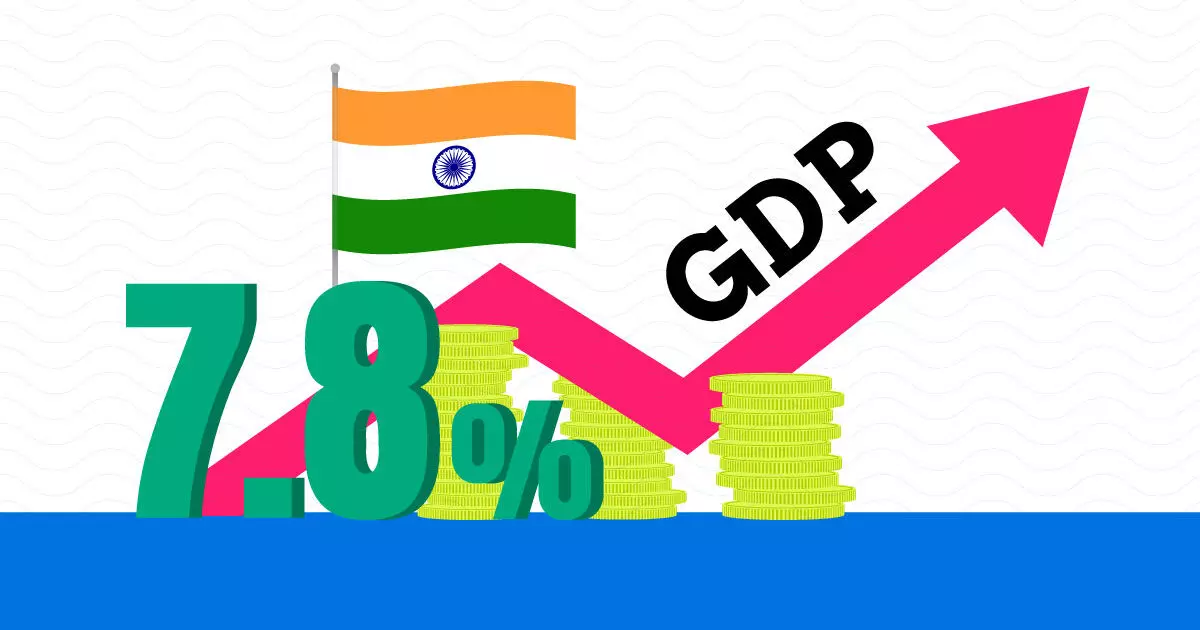
India’s real GDP grew 7.8% in the April-June quarter of FY2026-27, beating expectations and marking a strong start to the financial year. The growth was supported by manufacturing, services, investment, domestic consumption and exports, but its benefits for households and businesses will depend on how broadly the momentum continues.
India records a strong 7.8% GDP growth
India’s 7.8% GDP growth in Q1 FY2026-27 has emerged as one of the key economic developments of the year so far. According to the Ministry of Statistics and Programme Implementation, real GDP at constant prices was estimated at ₹81.36 lakh crore during April-June 2026, compared with ₹75.46 lakh crore in the same quarter a year earlier.
The latest number is higher than the 6.9% growth recorded in the corresponding quarter of FY2025-26. It also exceeded the Reserve Bank of India’s 7% forecast for the quarter. Nominal GDP grew 10.3% to ₹88.27 lakh crore during the period.
The growth is significant because it came amid geopolitical tensions, supply-chain disruptions and uncertainty around global trade. However, GDP growth is a measure of overall economic output. It does not automatically mean that every household, worker or small business will experience the same improvement in income.
Manufacturing and services remain key growth drivers
The composition of growth provides a better picture of where economic activity is coming from. Real GVA increased 8.2% in Q1 FY2026-27, with manufacturing and services making important contributions.
Manufacturing recorded strong growth during the quarter, while several service sectors also expanded. Construction, electricity and financial and professional services were among the areas supporting economic activity. At the same time, agriculture grew more slowly and mining contracted, showing that growth was not uniform across all parts of the economy.
For businesses outside major metropolitan areas, this distinction matters. A stronger manufacturing and services cycle can create demand for transport, warehousing, retail, repair services, local suppliers and other supporting businesses in smaller cities and towns.
What 7.8% GDP growth means for jobs
A common question after strong GDP data is whether it will translate into more jobs. The answer is not immediate or automatic.
When businesses experience stronger demand, they may increase production, expand capacity or open new locations. That can create demand for workers. Manufacturing expansion can support factory employment as well as jobs in logistics, maintenance, packaging and distribution. Services growth can create opportunities across finance, technology, retail, hospitality, transportation and professional services.
The latest labour data provides some useful context. MoSPI’s July 2026 Periodic Labour Force Survey shows a labour force participation rate of 55.4% for people aged 15 years and above, while the worker population ratio was 52.5%. The unemployment rate stood at 5.1% under the current weekly status measure. Urban unemployment was 6.7%, compared with 4.5% in rural areas.
These figures underline why GDP growth and employment numbers should be viewed together. A growing economy needs to generate enough productive work to make the expansion meaningful for the wider population.
Small businesses could benefit from stronger demand
Micro, small and medium enterprises are closely connected to consumption, manufacturing and local services. When demand increases, small businesses can benefit through higher sales and greater orders from larger companies.
For example, a manufacturing expansion can increase business for local transport operators, component suppliers, packaging companies and maintenance providers. In smaller towns, stronger consumer demand can support retailers, restaurants, repair businesses, service providers and other local enterprises.
The latest GDP data also shows that investment increased 11.9% in real terms in Q1 FY2026-27, while household consumption grew 7.1%. Exports increased 12%.
For small businesses, stronger consumption is particularly important because it directly affects customer demand. However, higher sales do not necessarily translate into higher profits. Input costs, wages, borrowing costs and competition can still affect margins.
Consumers may see the impact through income and demand
GDP growth can affect consumers through several channels. If companies expand and hiring improves, more households may experience higher employment or income. Businesses can also increase spending on wages, expansion and new products when they are confident about future demand.
The 7.1% increase in household consumption in Q1 FY2026-27 is therefore an important part of the growth story. It suggests that domestic demand remained supportive during the quarter.
But consumers should not interpret GDP growth as an immediate increase in their purchasing power. GDP measures production and economic activity, while household financial conditions depend on income growth, inflation, employment, interest rates and household expenses.
This is especially relevant for middle-income and lower-income households, where food, housing, transport, education and healthcare costs can have a large effect on disposable income.
Rural and Tier-2 markets remain important
The strength of domestic demand matters beyond India’s largest cities. Tier-2 and Tier-3 markets have become increasingly important for retailers, consumer brands, financial institutions, digital businesses and service providers.
A sustained economic expansion could encourage businesses to invest in distribution networks and expand their presence in smaller cities. Better connectivity, digital payments and online commerce can also allow small businesses to reach customers beyond their immediate markets.
However, rural and semi-urban demand can be influenced by factors such as agricultural income, monsoon conditions, food prices and local employment. The latest GDP figures show agriculture growing at a slower pace than several major service and industrial sectors, which means the overall headline growth rate should not be treated as a uniform measure of economic conditions across India.
Strong GDP growth does not remove economic risks
The 7.8% figure is encouraging, but there are reasons to remain cautious about the months ahead.
India continues to face external risks linked to global trade, geopolitical tensions, commodity prices and energy costs. Businesses that depend heavily on imported raw materials can be particularly sensitive to changes in input prices.
There has also been public discussion about the methodology behind the latest GDP estimates, particularly the treatment of manufacturing prices and the impact of the new national accounts series. The statistics ministry has defended the estimates and said the changes reflect methodological improvements, revised data and the use of a new 2022-23 base year rather than an attempt to mechanically increase the growth rate.
For readers and businesses, the more useful approach is to look beyond the headline number and track employment, consumption, investment, inflation and sector-level performance together.
What the 7.8% growth means going forward
The first-quarter GDP number gives India a strong starting point for FY2026-27. Investment growth, household consumption and exports have provided support, while manufacturing and services have remained important contributors.
The bigger question is whether this pace can be sustained through the rest of the financial year.
For workers, sustained growth could improve hiring opportunities if businesses convert higher demand into new capacity and employment. For small businesses, stronger consumption and investment could mean more customers and orders. For consumers, the real benefit will depend on whether income and employment growth keep pace with living costs.
In other words, 7.8% GDP growth is a strong macroeconomic signal, but its real significance will be measured by what happens beyond the GDP tables: more jobs, stronger business activity, rising incomes and sustained consumer demand.
Key Takeaways
- India’s real GDP grew 7.8% in Q1 FY2026-27, up from 6.9% in the year-ago quarter.
- Household consumption increased 7.1%, while investment rose 11.9% during the quarter.
- Stronger economic activity could support jobs and small businesses, but GDP growth alone does not guarantee higher employment or incomes.
- External risks, input costs, inflation and uneven sectoral growth will remain important factors for the rest of FY2026-27.
Frequently Asked Questions
1. What is India’s latest GDP growth rate?
India’s real GDP grew 7.8% year-on-year in the April-June quarter of FY2026-27. The figure was higher than the 6.9% growth recorded in Q1 FY2025-26.
2. Will 7.8% GDP growth create more jobs in India?
Strong economic growth can support job creation when companies respond to higher demand by increasing production, investment and capacity. However, GDP growth alone does not guarantee that employment will rise at the same pace.
3. How can small businesses benefit from GDP growth?
Small businesses can benefit from stronger consumer demand, increased orders from larger companies and higher investment. Businesses linked to retail, manufacturing, logistics, services and local consumption may see opportunities if the growth momentum continues.
4. Does higher GDP growth mean consumers will have more money to spend?
Not necessarily. GDP growth reflects overall economic output. Consumer purchasing power also depends on wages, employment, inflation, interest rates and household expenses.











Leave a comment