

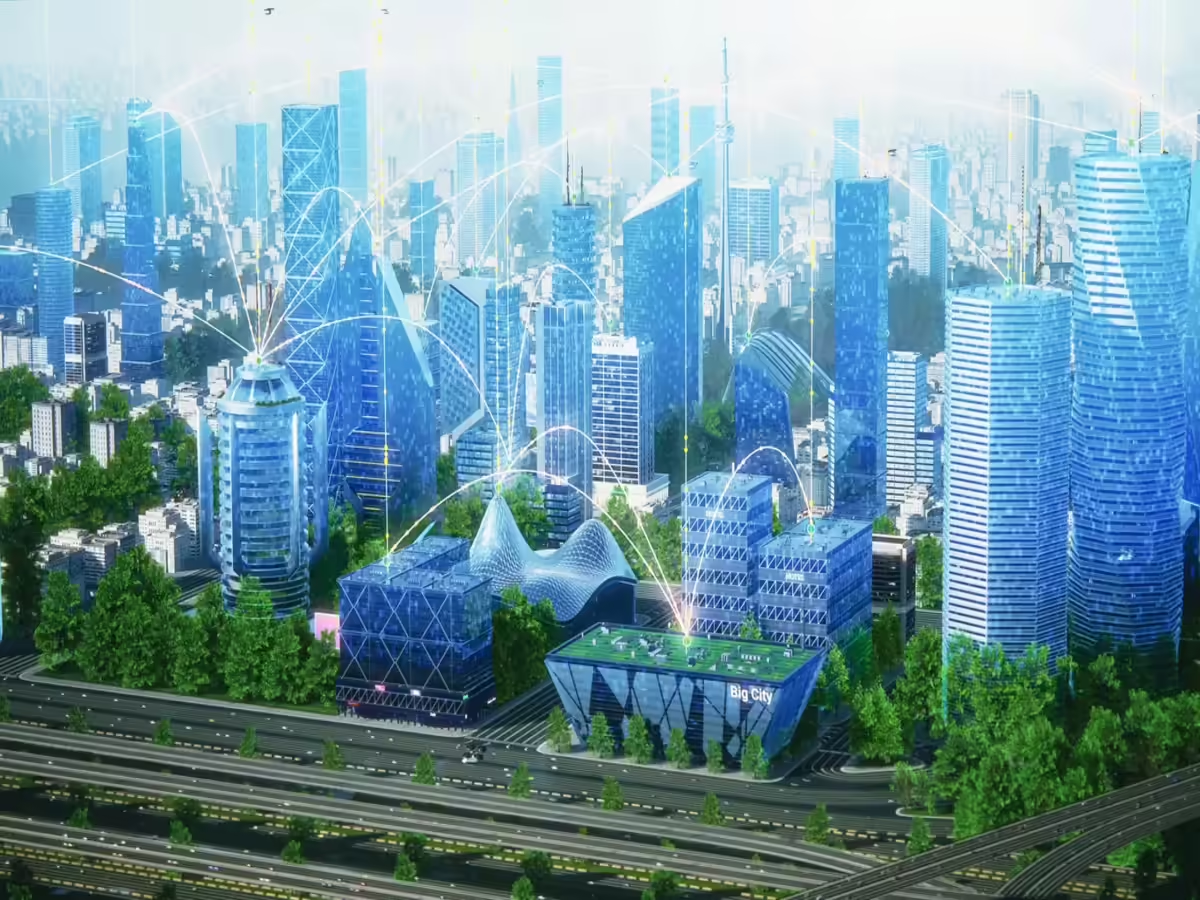
Maharashtra’s ambitious AI Policy 2026 aims to attract more than ₹10,000 crore in investments and create over 1.5 lakh jobs by 2031. While the announcement is a major technology story, its biggest impact may be felt in smaller cities where startups, MSMEs, students, and job seekers could gain access to new opportunities.
News Context: Maharashtra’s AI Push Gains Momentum
Maharashtra’s AI investment plan is a time-sensitive news development based on the state government’s recently approved AI Policy 2026. The policy targets over ₹10,000 crore in investments, more than 1.5 lakh AI-related jobs, and large-scale skill development by 2031. The state has also announced plans for AI Centres of Excellence, AI Innovation Cities, startup funding support, incubators, and computing infrastructure to accelerate adoption of artificial intelligence across industries.
The announcement reflects Maharashtra’s intention to position itself as a leading AI hub in India while supporting innovation, research, governance, manufacturing, and digital services.
What the ₹10,000 Crore AI Investment Plan Includes
The policy goes beyond attracting private investment. It outlines a broader ecosystem designed to encourage AI development and adoption across the state.
Key initiatives include:
- Six AI Centres of Excellence across administrative divisions
- Five AI Innovation Cities
- Twelve AI incubators
- A ₹500 crore AI startup fund
- Shared AI computing infrastructure with GPU access
- Support for AI adoption among MSMEs
- AI skill development programs targeting around two lakh individuals
The government has also indicated that AI applications will be encouraged across public services, industry, education, healthcare, agriculture, and governance.
For businesses, the policy signals long-term support for technology-led growth rather than a short-term funding initiative.
Why Smaller Cities Could Benefit the Most
One of the most important aspects of the AI policy is its potential impact outside Mumbai and Pune.
Cities such as Nagpur, Nashik, Aurangabad, Kolhapur, Amravati, Solapur, and other emerging urban centres have increasingly attracted technology investments due to lower operating costs, growing infrastructure, and expanding talent pools.
AI incubators and Centres of Excellence distributed across regions could help startups access mentorship, research facilities, funding networks, and technical resources without relocating to major metropolitan hubs.
For local entrepreneurs, this reduces one of the biggest barriers to innovation: access to capital and advanced technology infrastructure.
The policy could also encourage educational institutions in Tier-2 and Tier-3 cities to introduce AI-focused courses, creating stronger connections between industry requirements and academic training.
Opportunities for Startups and MSMEs
Artificial intelligence is no longer limited to large technology companies. Small businesses are increasingly using AI for customer support, marketing automation, inventory management, predictive analytics, and operational efficiency.
Maharashtra’s AI policy specifically mentions support for startups and MSMEs, which form a significant part of the state’s economy.
Businesses operating in manufacturing clusters, logistics hubs, healthcare services, retail, agriculture technology, and financial services could benefit from AI adoption incentives and access to shared infrastructure.
For startups, the dedicated funding ecosystem may create opportunities to develop solutions tailored to regional challenges such as agricultural productivity, local language services, healthcare accessibility, and supply chain management.
This is particularly relevant for entrepreneurs in smaller cities who understand local market needs but often struggle to access technology resources.
What It Means for Job Seekers
The target of creating more than 1.5 lakh jobs has generated significant interest among students and professionals.
However, the employment impact will likely extend beyond software engineering roles.
AI growth typically creates demand for:
- Data analysts
- AI trainers
- Machine learning engineers
- Cybersecurity specialists
- Cloud computing professionals
- Digital marketing experts
- Business analysts
- Product managers
- Technical support specialists
Many companies also require domain experts who understand industries such as banking, healthcare, manufacturing, agriculture, and education.
As a result, graduates from commerce, management, science, engineering, and even humanities backgrounds may find opportunities in AI-enabled sectors after acquiring relevant digital skills.
Challenges That Must Be Addressed
Despite the positive outlook, several challenges remain.
Smaller cities still face gaps in advanced infrastructure, high-quality technical training, research facilities, and industry-academia collaboration. AI adoption among traditional businesses may also take time due to cost concerns and limited awareness.
Another challenge is ensuring that skill development programs align with actual industry requirements. Training large numbers of candidates is important, but employability will depend on practical experience and industry-relevant skills.
The success of the policy will therefore depend on effective execution, private sector participation, and continuous investment in talent development.
Takeaways
- Maharashtra aims to attract over ₹10,000 crore in AI investments by 2031.
- The policy targets creation of more than 1.5 lakh AI-related jobs.
- Smaller cities could benefit through incubators, innovation centres, and startup support.
- MSMEs, startups, students, and professionals may gain new opportunities from AI-driven growth.
FAQ
Is Maharashtra’s AI policy focused only on Mumbai and Pune?
No. The policy proposes AI infrastructure and innovation initiatives across multiple regions, which could benefit several Tier-2 and Tier-3 cities.
How many jobs does the policy aim to create?
The government has set a target of creating more than 1.5 lakh direct and indirect AI-related jobs by 2031.
Will non-technical professionals benefit from AI growth?
Yes. AI adoption creates opportunities in business analysis, operations, marketing, management, customer service, and industry-specific roles.
Why is the ₹10,000 crore investment target important?
The investment target indicates long-term government and industry commitment to building AI infrastructure, innovation ecosystems, and employment opportunities across Maharashtra.
(Keywords: Maharashtra AI Policy 2026, AI investment Maharashtra, AI jobs in Maharashtra, AI startups India, Maharashtra startup ecosystem, AI innovation cities, AI centres of excellence, MSME AI adoption, Tier 2 city startups, artificial intelligence jobs India)









Leave a comment