

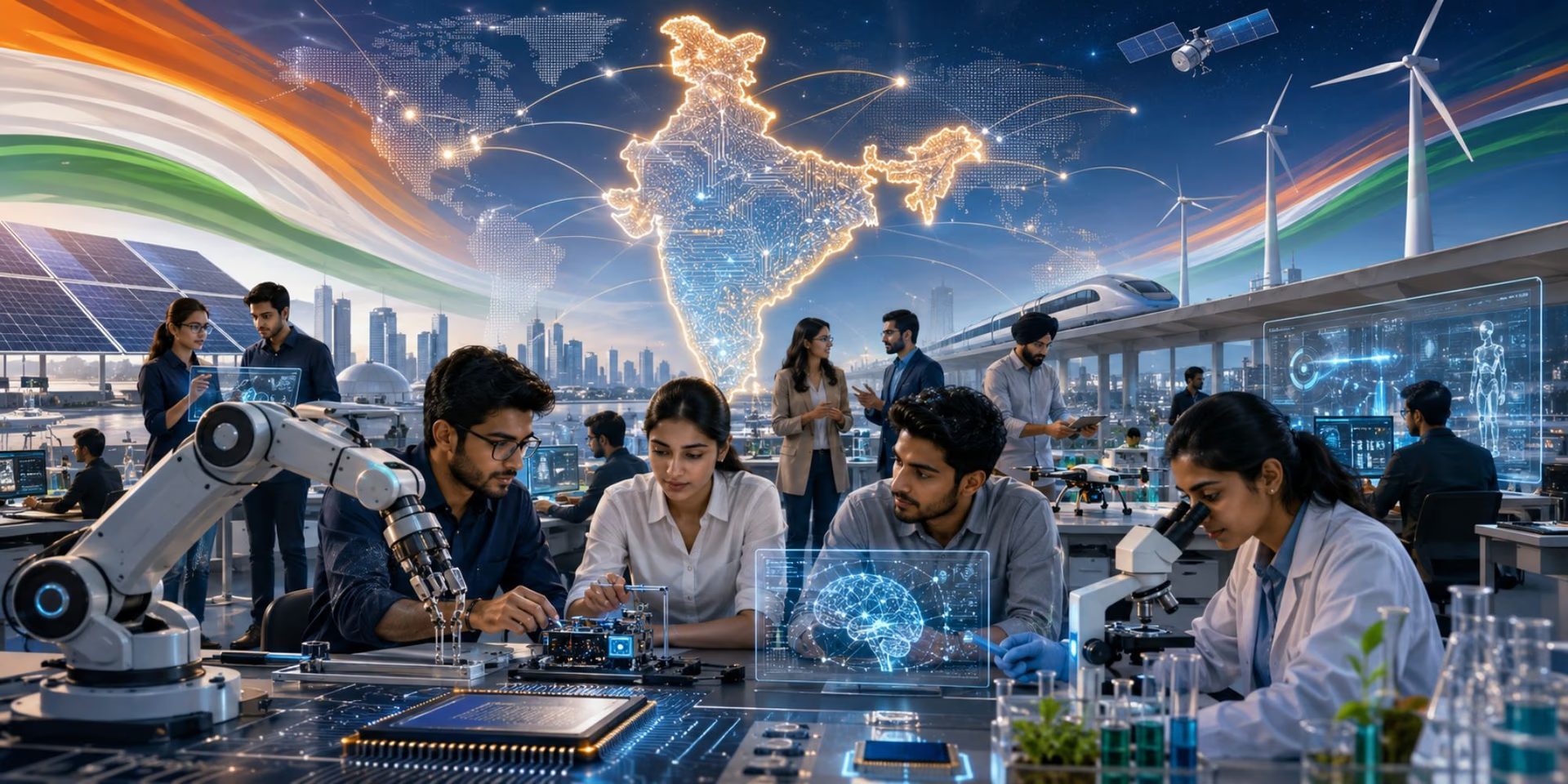
India’s deeptech sector is emerging as one of the country’s fastest-growing innovation ecosystems, driven by government support, rising venture capital interest, advances in artificial intelligence, semiconductors, space technology, and defence. Although funding remains selective, long-term confidence in deeptech continues to strengthen.
Time-sensitive or evergreen?
This is a time-sensitive news analysis. Recent government initiatives, venture capital activity, and major developments in India’s space, semiconductor, and AI sectors make the topic current. Therefore, this article follows a news reporting style while providing context.
India’s deeptech sector is becoming the next growth engine for the country’s startup ecosystem as investors, policymakers, and entrepreneurs increasingly focus on advanced technologies with global commercial potential. Unlike consumer internet startups, deeptech companies build products based on scientific research and engineering in areas such as artificial intelligence, semiconductors, robotics, biotechnology, quantum computing, aerospace, and climate technology. Recent developments indicate that India is witnessing a structural shift toward technology-led innovation backed by both government initiatives and private capital.
The momentum comes at a time when overall startup funding has become more selective. While the number of large funding rounds has moderated, investors continue to show strong confidence in deeptech businesses capable of solving complex industrial and strategic challenges.
Government Policy Is Accelerating Deeptech Innovation
One of the biggest drivers of India’s deeptech ecosystem is increased government support. Over the past year, policymakers have announced multiple initiatives aimed at strengthening domestic innovation in strategic sectors.
The government’s renewed semiconductor strategy under Semicon 2.0 includes milestone-based funding and equity participation in semiconductor startups instead of one-time grants. This approach aims to create sustainable companies while encouraging private investors to participate alongside public funding.
The Research, Development and Innovation (RDI) Fund has also emerged as a significant catalyst. According to recent reports, the Technology Development Board has selected 22 deeptech startups working across space, robotics, quantum computing, biotechnology, healthcare, electric mobility, climate technology and digital technologies. The approved projects represent thousands of crores in combined investment, highlighting the government’s long-term commitment to research-driven businesses.
Venture Capital Firms Are Increasing Their Deeptech Focus
Investor sentiment toward deeptech has strengthened considerably in 2026. Although funding values fluctuate depending on large investment rounds, venture capital firms continue launching specialised funds dedicated to artificial intelligence, semiconductors, advanced manufacturing and enterprise technologies.
Industry reports show that several investment firms have created dedicated AI and deeptech platforms, while established venture capital firms are allocating larger portions of their portfolios to frontier technologies. Investors believe the next generation of globally competitive Indian companies will emerge from sectors built on intellectual property rather than business model innovation alone.
This represents an important shift in India’s startup ecosystem. Earlier funding cycles largely favoured consumer internet businesses, food delivery, fintech and e-commerce. Today, investors increasingly recognise that deeptech startups can create defensible technologies with significant export potential.
Space, AI and Semiconductor Startups Are Leading Growth
Several sectors are contributing to India’s deeptech momentum.
Artificial intelligence continues to attract substantial investment as businesses integrate AI into healthcare, manufacturing, financial services, education and logistics. AI-native startups are also raising capital faster than many traditional software companies.
The space technology ecosystem has also gained visibility following recent achievements by private companies. Skyroot Aerospace’s successful milestones have strengthened investor confidence in India’s commercial space sector while inspiring more entrepreneurs to enter advanced engineering fields.
Similarly, semiconductor startups are benefiting from India’s strategic focus on reducing dependence on imported chips. Government incentives, coupled with growing domestic manufacturing ambitions, are creating opportunities for companies involved in chip design, fabrication technologies and supporting infrastructure.
Tier 2 Cities Are Emerging as Innovation Hubs
Deeptech innovation is no longer limited to Bengaluru, Hyderabad or Delhi.
Engineering colleges, incubation centres and research institutions across Tier 2 cities are producing founders working on robotics, agritech, medical devices, aerospace systems and industrial automation. Improved digital infrastructure and stronger collaboration between academia and industry are allowing entrepreneurs to commercialise research more effectively.
Cities including Coimbatore, Indore, Jaipur, Bhubaneswar, Ahmedabad and Nagpur are gradually becoming part of India’s broader innovation network. This geographical diversification strengthens the country’s long-term startup ecosystem while creating high-skilled employment outside traditional technology hubs.
As manufacturing expands under initiatives such as Make in India and semiconductor development programmes, demand for engineers, scientists and specialised technology professionals is also expected to increase.
Challenges Still Remain for Deeptech Startups
Despite growing optimism, deeptech entrepreneurship presents unique challenges.
Developing advanced technologies requires longer research cycles, higher capital requirements and specialised talent. Unlike software startups that can launch products quickly, deeptech companies often spend years developing prototypes before generating meaningful revenue.
Industry experts also point out that India’s growth-stage funding ecosystem for deeptech remains relatively limited. Early-stage investors are becoming more active, but companies developing complex technologies still require larger follow-on investments to compete globally.
Commercialising research, protecting intellectual property and accessing advanced testing infrastructure remain critical areas that need continued policy support.
India’s Long-Term Opportunity
The current momentum suggests that deeptech is evolving from a niche investment category into a strategic pillar of India’s innovation economy.
Government backing, stronger venture capital participation, expanding research capabilities and increasing founder ambition are creating favourable conditions for sustained growth. Rather than replicating global business models, many Indian founders are now developing original technologies aimed at solving worldwide challenges in healthcare, defence, manufacturing, clean energy and space exploration.
If this momentum continues, India’s deeptech ecosystem could become one of the country’s most significant economic growth drivers over the next decade while strengthening its position in global technology value chains.
Key Takeaways
- Government initiatives are providing stronger financial and policy support for deeptech startups.
- Venture capital firms are increasing investments in AI, semiconductors, robotics and advanced technologies.
- Space technology, artificial intelligence and semiconductor startups are driving sector growth.
- Tier 2 cities are playing a larger role in India’s expanding deeptech innovation ecosystem.
FAQ
Q1. What is a deeptech startup?
A deeptech startup develops products based on scientific research or advanced engineering in fields such as AI, robotics, biotechnology, semiconductors, quantum computing or aerospace.
Q2. Why are investors focusing on deeptech in 2026?
Investors believe deeptech companies can build globally competitive technologies with strong intellectual property and long-term commercial value.
Q3. Which sectors are leading India’s deeptech growth?
Artificial intelligence, semiconductors, space technology, robotics, biotechnology, climate technology and advanced manufacturing are among the fastest-growing sectors.
Q4. Can Tier 2 cities contribute to India’s deeptech ecosystem?
Yes. Engineering talent, incubation centres, research institutions and improving infrastructure are enabling startups from Tier 2 cities to build globally relevant technologies.












Leave a comment