

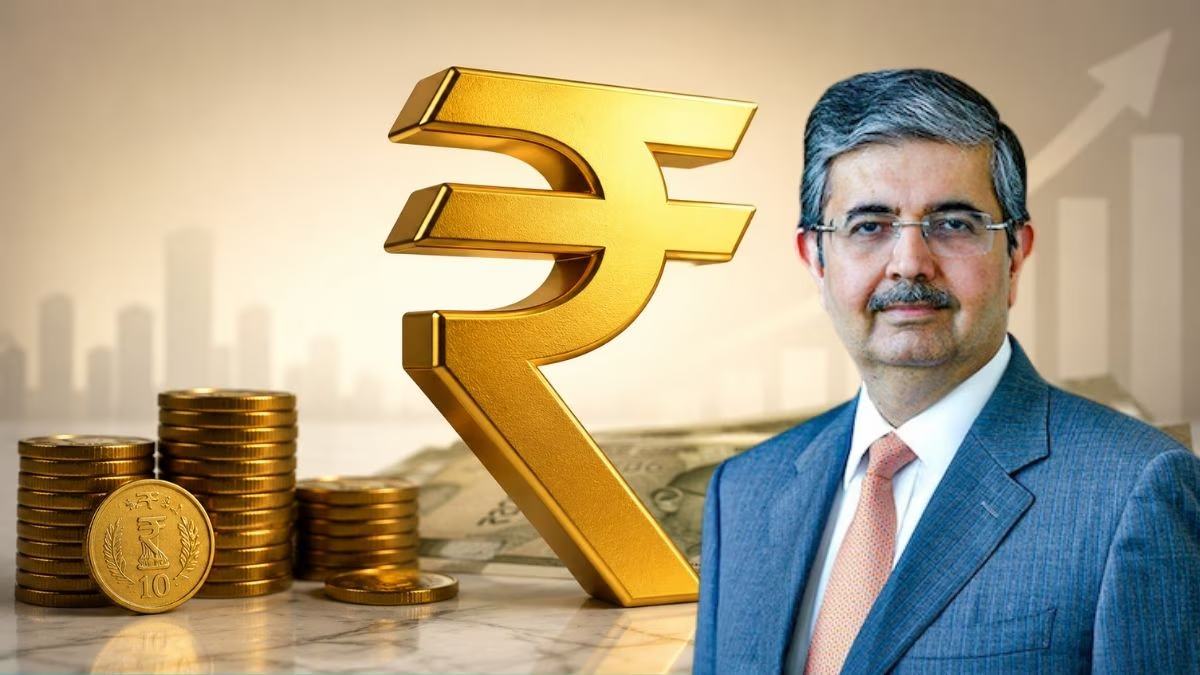
Uday Kotak’s warning on foreign capital dependence has sparked an important debate in India’s financial and business circles. The veteran banker argues that India must strengthen domestic sources of capital to build resilient businesses and reduce vulnerability to global investment cycles.
Why Uday Kotak’s Warning Matters in 2026
Uday Kotak’s warning on foreign capital dependence comes at a time when India is attracting strong interest from global investors. Foreign portfolio investors, sovereign funds, private equity firms, and venture capital funds have played a major role in financing Indian startups, listed companies, and infrastructure projects.
Speaking at recent industry forums, Uday Kotak emphasized that while foreign investment has helped accelerate India’s growth, excessive dependence can create long-term risks.
His core message is straightforward: India should continue welcoming international capital, but it must also build deeper pools of domestic savings and institutional capital.
How Foreign Capital Has Shaped India’s Growth
Over the past two decades, foreign capital has funded some of India’s most successful companies. Global investors backed technology startups, telecom expansion, renewable energy projects, and financial services businesses.
Indian startups such as Flipkart, Paytm, and Zomato grew rapidly with support from overseas investors.
Foreign institutional investors also remain major participants in India’s stock market. Their investments improve liquidity and often support market valuations.
At the same time, these flows can reverse quickly when global interest rates rise, currencies become volatile, or risk appetite weakens.
Risks of Overdependence on Overseas Investment
When businesses rely too heavily on foreign capital, they become exposed to external shocks that are beyond their control.
Sudden Capital Outflows
Global investors can reduce exposure to emerging markets during periods of uncertainty, causing pressure on stock prices and the rupee.
Valuation Distortions
Easy access to overseas money can push valuations to unsustainable levels, particularly in startups.
Strategic Vulnerability
Critical sectors may become dependent on funding decisions made outside India.
Limited Domestic Ownership
A larger share of wealth creation may accrue to foreign investors instead of Indian savers.
Kotak’s warning reflects these broader structural concerns rather than opposition to international investment.
Why Domestic Capital Is Becoming More Important
Domestic capital includes household savings, mutual funds, insurance funds, pension money, and family offices.
India is in a stronger position today than a decade ago. Systematic investment plans into mutual funds continue to bring consistent retail participation, and insurance and pension assets are expanding steadily.
This gives India an opportunity to finance more of its growth internally.
For businesses, a stronger domestic investor base can provide greater stability and reduce dependence on global sentiment.
What This Means for Indian Startups
The startup ecosystem has historically relied on foreign venture capital, especially from the United States, Singapore, and Japan.
Kotak’s remarks could encourage greater participation from domestic investors, including:
- Family offices
- Corporate venture funds
- Domestic venture capital firms
- Pension and insurance-backed funds
This shift may lead to more disciplined capital allocation and business models focused on sustainable profitability.
For founders in Tier-2 and Tier-3 cities, stronger domestic capital could improve access to investors who better understand local markets and consumer behavior.
Implications for SMEs and Traditional Businesses
The message is equally relevant for small and medium enterprises.
Many SMEs depend on bank loans, but as alternative financing options expand, domestic private credit and local investment networks may become more significant.
Businesses that build strong governance, predictable cash flows, and transparent reporting are more likely to attract Indian investors.
This can help entrepreneurs reduce reliance on volatile international funding conditions.
Balancing Foreign and Domestic Capital
Kotak is not arguing that India should reduce foreign investment. International capital remains essential for sectors that require large and long-term investments.
The broader point is that a healthy economy needs balance.
Countries with strong domestic financial systems are generally better positioned to withstand global volatility while continuing to fund growth.
India’s rising household savings and maturing capital markets make this goal increasingly realistic.
What Indian Businesses Should Do
Business leaders can draw several lessons from Kotak’s comments.
They should diversify funding sources, improve governance standards, and focus on sustainable economics rather than relying solely on abundant capital.
Companies with resilient balance sheets are better equipped to navigate changing market conditions.
In the long run, access to both domestic and foreign capital will provide the strongest foundation for growth.
Key Takeaways
- Uday Kotak has cautioned against excessive dependence on foreign capital.
- Domestic savings and institutions can provide more stable long-term funding.
- Startups and SMEs should diversify their sources of capital.
- Balanced financing reduces vulnerability to global market swings.
FAQ
What did Uday Kotak say about foreign capital?
He emphasized that India should strengthen domestic capital pools rather than relying too heavily on overseas investors.
Does this mean India should stop accepting foreign investment?
No. The message is about balance, not reducing foreign participation.
Why is domestic capital important?
It provides a more stable and locally aligned source of funding.
How can businesses benefit from this shift?
They can access more resilient funding and reduce exposure to global volatility.











Leave a comment