

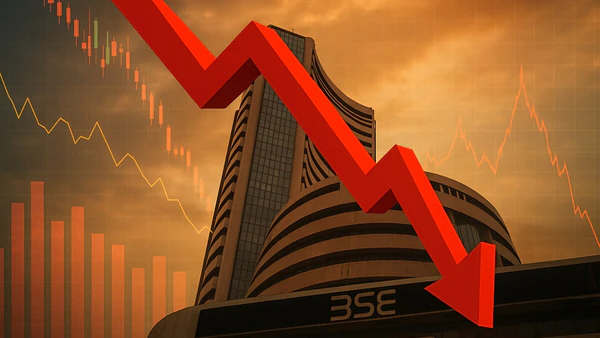
The Indian stock market opened lower today, with the Nifty50 dropping about 0.3 % and the BSE Sensex falling over 200 points in early trade. Domestic sentiment was cautious amid weak global cues, sectoral weakness and profit-booking by some institutional investors.
Global cues and Fed policy jitters
The Nifty and Sensex opened on a weak footing largely because global markets turned cautious. In the U.S. and Asia, investors pulled back ahead of upcoming jobs data and a key earnings cycle — concerns that a near-term rate cut by the Federal Reserve may slip further dampened risk sentiment. Meanwhile, domestic institutional flows are getting affected by the global pull-back.
When overseas markets are down, India’s indices often take the lead. For smaller-city investors, this means that what happens on Dalal Street is not just local fundamentals — it is also global macro.
Sectoral drag hits mid and small caps
Beyond the headline numbers, the weakness was broad-based: metal, realty, technology and consumer goods sectors opened in the red. For example, the metal index dropped nearly 1 % in early trade, and many mid-cap and small-cap stocks followed suit.
Smaller-city investors who hold exposure in non-blue-chip names or regional companies need to watch this closely. Sectoral slowdowns ripple faster in mid and small-caps, and such open-ning weakness may set the tone for the day.
Profit-booking after recent run-up
The market had been on a six-session winning streak, powered by strong earnings, supportive policy moves for exporters and improving domestic demand. Today’s decline reflects some profit-booking and consolidation at higher levels.
For regional investors who entered recently — either through small‐cap stocks or via mutual funds — this is a reminder that markets don’t move straight up. A session like today can trigger stop-losses or margin calls in smaller towns where risk awareness may be lower.
What this opening means for investors outside metros
- Hold the longer view, but monitor exposures — For smaller-city investors positioned in good quality stocks, a red open isn’t alarming. But it is a prompt to check if sectoral and corporate fundamentals still hold.
- Favor large and mid-caps over highly volatile small names — In uncertain sessions, blue-chips tend to hold up better. Smaller towns often see retail participation in smaller companies; today’s bias suggests caution there.
- Be wary of fresh entries purely because market is down — The impulse to buy dip is natural, but without analyzing why the market is down (global flow, sector weakness, domestic profit-booking), one may catch a falling knife.
- Use this as an opportunity to review asset allocation — Especially in Tier-2/Tier-3 cities where financial advisory may be limited, a red opening is a good time to check if one’s portfolio is still aligned with risk tolerance and goals.
Takeaways
- The dip in Sensex and Nifty reflects global macro concerns, not just local weakness.
- Sectoral weakness in metal, realty and small-caps signals that losses may widen beyond headline numbers.
- Smaller-city investors in non-blue-chip stocks need to tread carefully when markets open weak.
- Use today’s correction to review portfolio strategy, not to panic-sell or chase dips blindly.
FAQs
Q: Does a red opening mean the market will close down?
A: Not necessarily. Opening weakness is a signal of caution, but markets often reverse intraday if fresh positive triggers arrive. Closing outcomes depend on mid-session developments.
Q: Should investors in Tier-2/3 cities sell their holdings when market opens weak?
A: No. If the holdings are quality stocks and the investor horizon is long term, selling on short-term volatility may hurt. But one should review exposures and avoid adding new high-risk bets just because the market is down.
Q: What should small investors focus on today after this opening?
A: Focus on sectors you are exposed to—see if the companies you hold are in weak sectors. Check whether recent fundamentals have changed. Avoid reacting only to the red open; analyse whether the reason for weakness is transient or structural.
Q: How much weight should I give global factors in my Indian equity investments?
A: Quite a bit. In today’s interconnected markets, global rate trends, currency flows, commodity moves and foreign investor behaviour all affect Indian equities. For smaller-city investors, understanding global cues adds context beyond local news.












Leave a comment